Advertisements
Advertisements
प्रश्न
What do you mean by the conservation of momentum? Briefly, explain the collision between two bodies and the conservation of momentum.
Advertisements
उत्तर
Conservation of momentum in case of a collision between two bodies means the total momentum before and after collision remains unchanged or conserved, provided no net force acts on the system.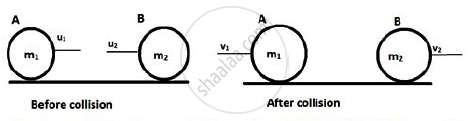
Consider two bodies A and 8 having masses m1 and m, and initial velocities u1 and u, respectively. The bodies collide head on with each other and their collision lasts for t seconds. Suppose the velocities of A and 8 after collision are v1 and v, respectively. Assume that no external forces are acting on the bodies.
Rate of change of momentum of ball A = m1(v1 - u1)/t .
Rate of change of momentum of ball 8 = m1 (v1 - u1)/t .
If FAB is the force exerted by A on 8 and FBA is the force ex
Rated by 8 on A, we can write
FAB= m1(v1 - u1)/t .
FBA = m1 (v1 - u1)/t .
FAB = -FBA
m1(v1 - u1)/t = - m2(v2- u2)/t .
m1(v1 - u1) = - m2(v2- u2)
m1v1 +m2v2 = m1u1+m2u2
So total momentum after collision = total momentum before collision.
This proves conservation of momentum during collision.
APPEARS IN
संबंधित प्रश्न
Two blocks A and B of mass mA and mB , respectively, are kept in contact on a frictionless table. The experimenter pushes block A from behind, so that the blocks accelerate. If block A exerts force F on block B, what is the force exerted by the experimenter on block A?
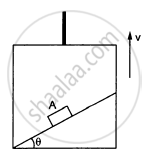
A block A can slide on a frictionless incline of angle θ and length l, kept inside an elevator going up with uniform velocity v in the following figure. Find the time taken by the block to slide down the length of the incline if it is released from the top of the incline.
A block is kept on the floor of an elevator at rest. The elevator starts descending with an acceleration of 12 m/s2. Find the displacement of the block during the first 0.2 s after the start. Take g = 10 m/s2.
How can Newton's first law of motion be obtained from the second law of motion?
The linear momentum of a ball of mass 50 g is 0.5 kg m s-1. Find its velocity.
A ball is thrown vertically upwards. It returns 6 s later. Calculate the greatest height reached by the ball. (Take g = 10 m s−2)
A stone is dropped freely from the top of a tower and it reaches the ground in 4 s. Taking g = 10m s-2, calculate the height of the tower.
Name the physical quantity which equals the rate of change of linear momentum.
A stone is dropped from a tower 98 m high. With what speed should a second stone be thrown 1 s later so that both hit the ground at the same time?
In the previous problem (5.3), the magnitude of the momentum transferred during the hit is ______.
