Advertisements
Advertisements
Question
The greater is the __________ the greater is the inertia of an object.
Advertisements
Solution
The greater is the MASS, the greater is the inertia of the object.
APPEARS IN
RELATED QUESTIONS
Give the magnitude and direction of the net force acting on a drop of rain falling down with a constant speed.
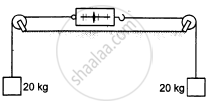
The figure shows a light spring balance connected to two blocks of mass 20 kg each. The graduations in the balance measure the tension in the spring. (a) What is the reading of the balance? (b) Will the reading change if the balance is heavy, say 2.0 kg? (c) What will happen if the spring is light but the blocks have unequal masses?
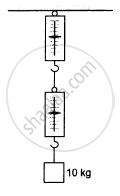
A block of mass 10 kg is suspended from two light spring balances, as shown in the following figure.
A force F1 acts on a particle accelerating it from rest to a velocity v. Force F1 is then replaced by F2 which decelerates the particle to rest.
A block of mass 2 kg placed on a long frictionless horizontal table is pulled horizontally by a constant force F. It is found to move 10 m in the first seconds. Find the magnitude of F.
Name the different kinds of inertia an object can possess. Give an example of each.
The amount of inertia of a body depends on its _________.
Name the scientist who first stated the law of inertia.
A body of mass 10 kg is acted upon by two perpendicular forces, 6 N and 8 N. The resultant acceleration of the body is ______.
- 1 m s–2 at an angle of tan−1 `(4/3)` w.r.t 6 N force.
- 0.2 m s–2 at an angle of tan−1 `(4/3)` w.r.t 6 N force.
- 1 m s–2 at an angle of tan−1 `(3/4)` w.r.t 8 N force.
- 0.2 m s–2 at an angle of tan−1 `(3/4)` w.r.t 8 N force.
How is force defined according to Newton’s First Law?
