Advertisements
Advertisements
प्रश्न
A particle is found to be at rest when seen from a frame S1 and moving with constant velocity when seen from another frame S2. Mark out the possible options.
(a) Both the frames are inertial.
(b) Both the frames are non-inertial.
(c) S1 is inertial and S2 is non-inertial.
(d) S1 is non-inertial and S2 is inertial
Advertisements
उत्तर
(a) Both the frames are inertial.
(b) Both the frames are non-inertial.
S1 is moving with constant velocity w.r.t frame S2. So, if S1 is inertial, then S2 will be inertial and if S1 is non-inertial, then S2 will be non-inertial.
APPEARS IN
संबंधित प्रश्न
It is sometimes heard that the inertial frame of reference is only an ideal concept and no such inertial frame actually exists. Comment.
The acceleration of a particle is zero, as measured from an inertial frame of reference. Can we conclude that no force acts on the particle?
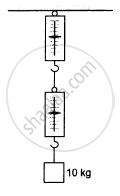
A block of mass 10 kg is suspended from two light spring balances, as shown in the following figure.
The force exerted by the floor of an elevator on the foot of a person is more than the weight of the person if the elevator is
(a) going up and slowing down
(b) going up and speeding up
(c) going down and slowing down
(d) going down and speeding up
A particle is observed from two frames S1 and S2. Frame S2 moves with respect to S1with an acceleration a. Let F1 and F2 be the pseudo forces on the particle when seen from S1 and S2, respectively. Which of the following is not possible?
A block of 2 kg is suspended from a ceiling by a massless spring of spring constant k = 100 N/m. What is the elongation of the spring? If another 1 kg is added to the block, what would be the further elongation?
State and explain the law of inertia (or Newton's first law of motion).
Explain the following :
After alighting from a moving bus , one has to run for some distance in the direction of bus in order to avoid falling .
A force of 600 dynes acts on a glass ball of mass 200 g for 12 s. If initially, the ball is at rest, find
- Final velocity
- Distance covered.
The greater is the __________ the greater is the inertia of an object.
Give two examples of the following:
Inertia of motion
Differentiate between gravitational mass and inertial mass.
Newton's first law of motion describes ______.
A body of mass 10 kg is acted upon by two perpendicular forces, 6 N and 8 N. The resultant acceleration of the body is ______.
- 1 m s–2 at an angle of tan−1 `(4/3)` w.r.t 6 N force.
- 0.2 m s–2 at an angle of tan−1 `(4/3)` w.r.t 6 N force.
- 1 m s–2 at an angle of tan−1 `(3/4)` w.r.t 8 N force.
- 0.2 m s–2 at an angle of tan−1 `(3/4)` w.r.t 8 N force.
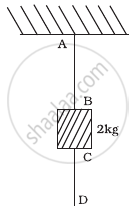
A mass of 2 kg is suspended with thread AB (Figure). Thread CD of the same type is attached to the other end of 2 kg mass. Lower thread is pulled gradually, harder and harder in the downward directon so as to apply force on AB. Which of the threads will break and why?
A smooth sphere of radius R and mass M is placed on the smooth horizontal floor. Another smooth particle of mass m is placed on the sphere and a horizontal force F is applied on the sphere as shown. If the particle does not slip on the sphere then the value of force F is ______.

A force F is applied to the initially stationary cart. The variation of force with time is shown in the figure. The speed of the cart at t = 5 sec is ______.

This question has Statement 1 and Statement 2. Of the four choices given after the Statements, choose the one that best describes the two Statements.
Statement 1: If you push on a cart being pulled by a horse so that it does not move, the cart pushes you back with an equal and opposite force.
Statement 2: The cart does not move because the force described in statement 1 cancel each other.
What does inertia measure in an object?
