Advertisements
Advertisements
प्रश्न
If the speed of the stone is increased beyond the maximum permissible value, and the string breaks suddenly, which of the following correctly describes the trajectory of the stone after the string breaks?
पर्याय
The stone moves radially outwards.
The stone flies off tangentially from the instant the string breaks.
The stone flies off at an angle with the tangent whose magnitude depends on the speed of the particle.
Advertisements
उत्तर
The stone flies off tangentially from the instant the string breaks.
Explanation:
The trajectory of the stone after the string breaks, i.e., the stone flies off tangentially from the instant the string breaks.The velocity is always tangential to the circle at every point during the circular motion. When the string breaks, the particle proceeds to move in the tangential direction in accordance with Newton's first law of motion.
APPEARS IN
संबंधित प्रश्न
Find the acceleration produced by a force of 5 N acting on a mass of 10 kg.
Is it possible for a particle to describe a curved path if no force acts on it? Does your answer depend on the frame of reference chosen to view the particle?
In an imaginary atmosphere, the air exerts a small force F on any particle in the direction of the particle's motion. A particle of mass m projected upward takes time t1 in reaching the maximum height and t2 in the return journey to the original point. Then.
A particle is found to be at rest when seen from a frame S1 and moving with constant velocity when seen from another frame S2. Mark out the possible options.
(a) Both the frames are inertial.
(b) Both the frames are non-inertial.
(c) S1 is inertial and S2 is non-inertial.
(d) S1 is non-inertial and S2 is inertial
When a train starts, the head of a standing passenger seems to be pushed backward. Analyse the situation from the ground frame. Does it really go backward? Coming back to the train frame, how do you explain the backward movement of the head on the basis of Newton's laws?
State Newton's first law of motion.
Give qualitative definition of force on the basic of Newton's first law of motion.
Give one example each of inertia of rest and inertia of motion.
Name the different kinds of inertia an object can possess. Give an example of each.
Differentiate between gravitational mass and inertial mass.
Classify the types of force based on their application.
When a bus suddenly takes a tum, the passengers are thrown outwards because of
A car of mass m starts from rest and acquires a velocity along east `v = vhati (v > 0)` in two seconds. Assuming the car moves with uniform acceleration, the force exerted on the car is ______.
A mass of 2 kg is suspended with thread AB (Figure). Thread CD of the same type is attached to the other end of 2 kg mass. Lower thread is pulled gradually, harder and harder in the downward directon so as to apply force on AB. Which of the threads will break and why?
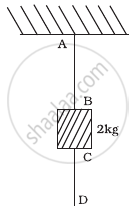
In the above given problem if the lower thread is pulled with a jerk, what happens?
In a legend, the hero-kid kicked a toy pig so that it is projected with a speed greater than that of its cry. If the weight of the toy pig is assumed to be 5 kg and the time of contact 0.01 sec., the force with which the hero-kid kicked him was ______.
(Speed of cry = 330 m/s)
The masses of 10 kg and 20 kg, respectively, are connected by massless spring as shown in the figure. A force of 200 N acts on the 20 kg mass. At the instant shown, the 10 kg mass has acceleration of 12 m/s2. What is the acceleration of 20 kg mass?
(g = 10 m/s2)

A balloon has mass of 10 g in air. The air escapes from the balloon at a uniform rate with velocity 4.5 cm/s. If the balloon shrinks in 5 s completely. Then, the average force acting on that balloon will be (in dyne).
If the net force on an object is zero, what happens?
