Advertisements
Advertisements
प्रश्न
Explain the following :
After alighting from a moving bus , one has to run for some distance in the direction of bus in order to avoid falling .
Advertisements
उत्तर
When people alight from a moving bus, they continue to run alongside the bus to avoid falling. If they were to stop at once, the feet would come to rest suddenly but the upper part of the body would still be in motion and they would tend to fall forward.
APPEARS IN
संबंधित प्रश्न
Give the magnitude and direction of the net force acting on a drop of rain falling down with a constant speed.
The driver of a three-wheeler moving with a speed of 36 km/h sees a child standing in the middle of the road and brings his vehicle to rest in 4.0 s just in time to save the child. What is the average retarding force on the vehicle? The mass of the three-wheeler is 400 kg and the mass of the driver is 65 kg.
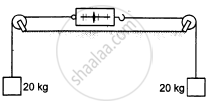
The figure shows a light spring balance connected to two blocks of mass 20 kg each. The graduations in the balance measure the tension in the spring. (a) What is the reading of the balance? (b) Will the reading change if the balance is heavy, say 2.0 kg? (c) What will happen if the spring is light but the blocks have unequal masses?
Three rigid rods are joined to form an equilateral triangle ABC of side 1 m. Three particles carrying charges 20 μC each are attached to the vertices of the triangle. The whole system is at rest in an inertial frame. The magnitude of the resultant force on the charged particle at A is.
A block of mass 2 kg placed on a long frictionless horizontal table is pulled horizontally by a constant force F. It is found to move 10 m in the first seconds. Find the magnitude of F.
A force of 600 dynes acts on a glass ball of mass 200 g for 12 s. If initially, the ball is at rest, find
- Final velocity
- Distance covered.
The greater is the __________ the greater is the inertia of an object.
The amount of inertia of a body depends on its _________.
Match the following.
| Column I | Column II |
| a. Newton’s I law | propulsion of a rocket |
| b. Newton’s II law | Stable equilibrium of the body |
| c. Newton’s III law | Law of force |
| d. Law of conservation of Linear momentum | Flying nature of bird |
What does inertia measure in an object?
