Advertisements
Advertisements
प्रश्न
When a train starts, the head of a standing passenger seems to be pushed backward. Analyse the situation from the ground frame. Does it really go backward? Coming back to the train frame, how do you explain the backward movement of the head on the basis of Newton's laws?
Advertisements
उत्तर
No, w.r.t. the ground frame, the person's head is not really pushed backward.
As the train moves, the lower portion of the passenger's body starts moving with the train, but the upper portion tries to be in rest according to Newton's first law and hence, the passenger seems to be pushed backward.
APPEARS IN
संबंधित प्रश्न
Give the magnitude and direction of the net force acting on a drop of rain falling down with a constant speed.
Find the acceleration produced by a force of 5 N acting on a mass of 10 kg.
A plumb bob is hung from the ceiling of a train compartment. If the train moves with an acceleration 'a' along a straight horizontal track , the string supporting the bob makes an angle tan−1 (a/g) with the normal to the ceiling. Suppose the train moves on an inclined straight track with uniform velocity. If the angle of incline is tan−1 (a/g), the string again makes the same angle with the normal to the ceiling. Can a person sitting inside the compartment tell by looking at the plumb line whether the train is accelerating on a horizontal straight track or moving on an incline? If yes, how? If not, then suggest a method to do so.
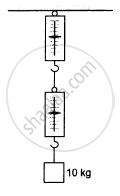
A block of mass 10 kg is suspended from two light spring balances, as shown in the following figure.
If you jump barefoot on a hard surface, your legs are injured. But they are not injured if you jump on a soft surface like sand or pillow. Why?
Explain the following :
After alighting from a moving bus , one has to run for some distance in the direction of bus in order to avoid falling .
Derive the relation between newton and dyne.
Give one example each of inertia of rest and inertia of motion.
Name the different kinds of inertia an object can possess. Give an example of each.
The amount of inertia of a body depends on its _________.
Match the following
| Column I | Column II |
| Newton’s I law | propulsion of a rocket |
| Newton’s II law | Stable equilibrium of a body |
| Newton’s III law | Law of force |
| Law of conservation of linear momentum | Flying nature of bird |
A mass of 2 kg is suspended with thread AB (Figure). Thread CD of the same type is attached to the other end of 2 kg mass. Lower thread is pulled gradually, harder and harder in the downward directon so as to apply force on AB. Which of the threads will break and why?
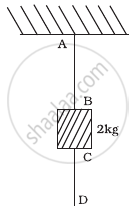
In the above given problem if the lower thread is pulled with a jerk, what happens?
In a legend, the hero-kid kicked a toy pig so that it is projected with a speed greater than that of its cry. If the weight of the toy pig is assumed to be 5 kg and the time of contact 0.01 sec., the force with which the hero-kid kicked him was ______.
(Speed of cry = 330 m/s)
A balloon has mass of 10 g in air. The air escapes from the balloon at a uniform rate with velocity 4.5 cm/s. If the balloon shrinks in 5 s completely. Then, the average force acting on that balloon will be (in dyne).
This question has Statement 1 and Statement 2. Of the four choices given after the Statements, choose the one that best describes the two Statements.
Statement 1: If you push on a cart being pulled by a horse so that it does not move, the cart pushes you back with an equal and opposite force.
Statement 2: The cart does not move because the force described in statement 1 cancel each other.
Match the following.
| Column I | Column II |
| a. Newton’s I law | propulsion of a rocket |
| b. Newton’s II law | Stable equilibrium of the body |
| c. Newton’s III law | Law of force |
| d. Law of conservation of Linear momentum | Flying nature of bird |
How is force defined according to Newton’s First Law?
When does an object accelerate?
An interstellar spacecraft, far away from the influence of any star or planet, is moving at high speed under the influence of fusion rockets (due to the thrust exerted by fusion rockets, the spacecraft is accelerating). Suddenly the engine malfunctions and stops. The spacecraft will ______.
