Advertisements
Advertisements
प्रश्न
If you jump barefoot on a hard surface, your legs are injured. But they are not injured if you jump on a soft surface like sand or pillow. Why?
Advertisements
उत्तर
In both the cases, change in momentum is same but the time interval during which momentum changes to zero is less in the first case. So, by `"F"="dp"/"dt"`, force in the first case will be more. That's why we are injured when we jump barefoot on a hard surface.
APPEARS IN
संबंधित प्रश्न
Name the scientist who gave the laws of motion.
Fill in the following blank with suitable word :
Newton’s first law of motion is also called Galileo’s law of ………………………
Define one newton force.
Find the acceleration produced by a force of 5 N acting on a mass of 10 kg.
Neglect the effect of rotation of the earth. Suppose the earth suddenly stops attracting objects placed near its surface. A person standing on the surface of the earth will.
Three rigid rods are joined to form an equilateral triangle ABC of side 1 m. Three particles carrying charges 20 μC each are attached to the vertices of the triangle. The whole system is at rest in an inertial frame. The magnitude of the resultant force on the charged particle at A is.
A force F1 acts on a particle accelerating it from rest to a velocity v. Force F1 is then replaced by F2 which decelerates the particle to rest.
The force exerted by the floor of an elevator on the foot of a person is more than the weight of the person if the elevator is
(a) going up and slowing down
(b) going up and speeding up
(c) going down and slowing down
(d) going down and speeding up
A particle is observed from two frames S1 and S2. Frame S2 moves with respect to S1with an acceleration a. Let F1 and F2 be the pseudo forces on the particle when seen from S1 and S2, respectively. Which of the following is not possible?
Give qualitative definition of force on the basic of Newton's first law of motion.
What do you mean by inertia of rest?
Give two examples of the following:
Inertia of rest
Differentiate between gravitational mass and inertial mass.
Match the following
| Column I | Column II |
| Newton’s I law | propulsion of a rocket |
| Newton’s II law | Stable equilibrium of a body |
| Newton’s III law | Law of force |
| Law of conservation of linear momentum | Flying nature of bird |
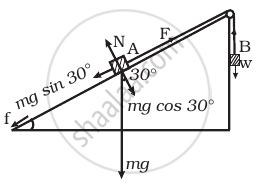
Block A of weight 100 N rests on a frictionless inclined plane of slope angle 30° (figure). A flexible cord attached to A passes over a frictonless pulley and is connected to block B of weight W. Find the weight W for which the system is in equilibrium.
Two blocks A and B of masses m and 2 m, respectively, are held at rest such that the spring is in natural length. Find out the accelerations of both the blocks just after release.

A balloon has mass of 10 g in air. The air escapes from the balloon at a uniform rate with velocity 4.5 cm/s. If the balloon shrinks in 5 s completely. Then, the average force acting on that balloon will be (in dyne).
If the net force on an object is zero, what happens?
What does inertia measure in an object?
