Advertisements
Advertisements
प्रश्न
Match the following
| Column I | Column II |
| Newton’s I law | propulsion of a rocket |
| Newton’s II law | Stable equilibrium of a body |
| Newton’s III law | Law of force |
| Law of conservation of linear momentum | Flying nature of bird |
Advertisements
उत्तर
| Column I | Column II |
| Newton’s I law | Stable equilibrium of a body |
| Newton’s II law | Law of force |
| Newton’s III law | Flying nature of bird |
| Law of conservation of linear momentum | Propulsion of a rocket |
APPEARS IN
संबंधित प्रश्न
State Newton’s first law of motion. Give two examples to illustrate Newton’s first law of motion.
A moving bicycle comes to rest after sometime if we stop pedalling it. But Newton’s first law of motion says that a moving body should continue to move for ever, unless some external force acts on it. How do you explain the bicycle case ?
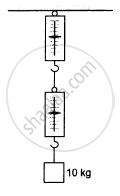
A block of mass 10 kg is suspended from two light spring balances, as shown in the following figure.
'When a hanging carpet is beaten with a stick, the dust particles start coming out of it'. This phenomenon can be best explained by making use of :
An object of mass 2 kg is sliding with a constant velocity of 4 m/s on a frictionless horizontal table. The force required to keep this object moving with the same velocity is :
State Newton's first law of motion.
Explain the following :
After alighting from a moving bus , one has to run for some distance in the direction of bus in order to avoid falling .
The greater is the __________ the greater is the inertia of an object.
The amount of inertia of a body depends on its _________.
Differentiate between gravitational mass and inertial mass.
