Advertisements
Advertisements
प्रश्न
The amount of inertia of a body depends on its _________.
Advertisements
उत्तर
The amount of inertia of a body depends on its MASS.
APPEARS IN
संबंधित प्रश्न
Fill in the following blank with suitable word :
Newton’s first law of motion is also called Galileo’s law of ………………………
Find the acceleration produced by a force of 5 N acting on a mass of 10 kg.
Name the law involved in the following situation :
if there were no friction and no air resistance, then a moving bicycle would go on moving for ever.
Is it possible for a particle to describe a curved path if no force acts on it? Does your answer depend on the frame of reference chosen to view the particle?
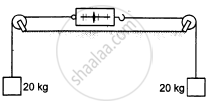
The figure shows a light spring balance connected to two blocks of mass 20 kg each. The graduations in the balance measure the tension in the spring. (a) What is the reading of the balance? (b) Will the reading change if the balance is heavy, say 2.0 kg? (c) What will happen if the spring is light but the blocks have unequal masses?
The force exerted by the floor of an elevator on the foot of a person is more than the weight of the person if the elevator is
(a) going up and slowing down
(b) going up and speeding up
(c) going down and slowing down
(d) going down and speeding up
A man riding on a car has ___________ Inertia.
Differentiate between gravitational mass and inertial mass.
If a 5 N and a 15 N forces are acting opposite to one another. Find the resultant force and the direction of action of the resultant force.
An insect is at the bottom of a hemispherical ditch of radius 1 m. It crawls up the ditch but starts slipping after it is at height h from the bottom. If the coefficient of friction between the ground and the insect is 0.75, then h is ______. (g = 10 ms−2)
