Advertisements
Advertisements
Question
What is the force which produces an acceleration of 1 m /s2 in a body of mass 1 kg ?
Advertisements
Solution
A force of 1 Newton produces an acceleration of 1 m/s2 in a body of 1 mass kg.
APPEARS IN
RELATED QUESTIONS
Fill in the following blanks with suitable words :
Forces in a Newton’s third law pair have equal _____________ but act in opposite _____________.
Why does a gunman get a jerk on firing a bullet ?
Do action and reaction act on the same body or different bodies ? How are they related in magnitude and direction ? Are they simultaneous or not ?
If a man jumps out from a boat, the boat moves backwards. Why ?
Why is it difficult to walk on a slippery road ?
State Newton’s third law of motion and give two examples to illustrate the law.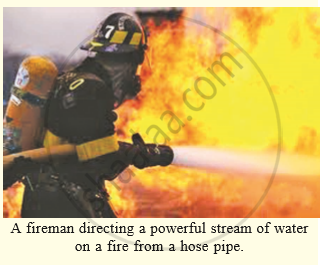
According to the third law of motion, action and reaction
Consider a frame that is made up of two thin massless rods AB and AC as shown in the figure. A vertical force `vec"P"` of magnitude 100 N is applied at point A of the frame.
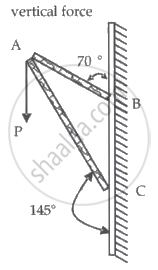
Suppose the force is `vec"P"` resolved parallel to the arms AB and AC of the frame.
The magnitude of the resolved component along the arm AC is xN.
The value of x, to the nearest integer, is ______.
[Given: sin(35°) = 0.573, cos(35°) = 0.819, sin(110°) = 0.939, cos(110°) = –0.342]
In a hose pipe ejecting water, what is the reaction force?
A book is resting on a table. Which of the following is the correct reaction force to the gravitational pull of the Earth on the book?
