Advertisements
Advertisements
Question
State Newton’s third law of motion and give two examples to illustrate the law.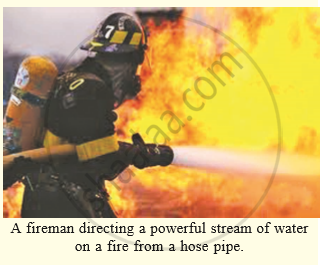
Advertisements
Solution
According to Newton’s third law of motion, whenever one body exerts a force on another body, the second body exerts an equal and opposite force on the first body.
Examples:
(i) Jet airplanes utilize the principle of action and reaction. In the modern jet aircraft, the hot gases obtained by the rapid burning of fuel rush out of a jet from the rear end of the aircraft at a great speed. The equal and opposite reaction of the backward-heading gases pushes the aircraft forward at a great speed.
(ii) While rowing a boat, the boatman pushes the water backwards with the oars. The water exerts an equal and opposite push on the boat which makes the boat move forward. In fact, harder the boatman pushes back the water with the oars, greater is the reaction force exerted by water and faster moves the boat, in forward direction.
APPEARS IN
RELATED QUESTIONS
According to the third law of motion, when we push on an object, the object pushes back on us with an equal and opposite force. If the object is a massive truck parked along the roadside, it will probably not move. A student justifies this by answering that the two opposite and equal forces cancel each other. Comment on this logic and explain why the truck does not move.
A girl weighing 25 kg stands on the tloor. She exerts a downward force of 250 N on the floor. What force does the floor exert on her ?
Why does a gunman get a jerk on firing a bullet ?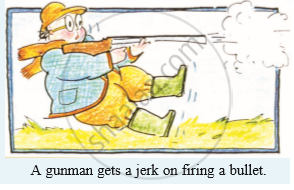
Explain how a rocket works.
Do action and reaction act on the same body or different bodies ? How are they related in magnitude and direction ? Are they simultaneous or not ?
Why is it difficult to walk on a slippery road ?
Draw a diagram to show how a rocket engine provides a force to move the rocket upwards. Label the diagram appropriately.
Give a scientific reason.
Even though the magnitudes of action force and reaction forces are equal and their directions are opposite, their effects do not get cancelled.
Give scientific reasons.
It is easier to stop a tennis ball as compared to a cricket ball when both are travelling with the same velocity.
“Wearing helmet and fastening the seat belt is highly recommended for safe journey” Justify your answer using Newton’s laws of motion.
