Advertisements
Advertisements
Question
Explain why, when a fireman directs a powerful stream of water on a fire from a hose pipe, the hose pipe tends to go backward.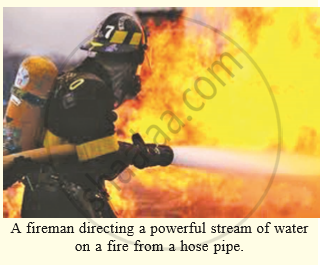
Advertisements
Solution
When a fireman directs a powerful stream of water on fire from a hose pipe, he has to hold the hose pipe strongly because of its tendency to go backwards. The backward movement of the hose pipe is due to the backward reaction of the water rushing through it in the forward direction at a great speed.
APPEARS IN
RELATED QUESTIONS
Using a horizontal force of 200 N, we intend to move a wooden cabinet across a floor at a constant velocity. What is the friction force that will be exerted on the cabinet?
According to the third law of motion, when we push on an object, the object pushes back on us with an equal and opposite force. If the object is a massive truck parked along the roadside, it will probably not move. A student justifies this by answering that the two opposite and equal forces cancel each other. Comment on this logic and explain why the truck does not move.
Is the following statement true or false :
A rocket can propel itself in a vacuum.
Fill in the following blanks with suitable words :
Forces in a Newton’s third law pair have equal _____________ but act in opposite _____________.
Why is it difficult to walk on a slippery road ?
Draw a diagram to show how a rocket engine provides a force to move the rocket upwards. Label the diagram appropriately.
According to the third law of motion, action and reaction :
Give a scientific reason.
Even though the magnitudes of action force and reaction forces are equal and their directions are opposite, their effects do not get cancelled.
According to the third law of motion, action and reaction
In a hose pipe ejecting water, what is the reaction force?
