Advertisements
Advertisements
Question
Complete a sentence and explain it.
The working of a rocket depends on Newton's ______ law of motion.
Advertisements
Solution
The working of a rocket depends on Newton’s third law of motion.
Explanation:
Newton's third law plays an important role in the acceleration of fire. When fuel is heated in a fire, a chemical reaction takes place and it burns. Free gases escape through a small hole in the tail on the ground side of the fireball. They exert an equal and opposite reaction force on fire. Due to this reaction force, the fire arrow accelerates forward.
APPEARS IN
RELATED QUESTIONS
If action is always equal to the reaction, explain how a horse can pull a cart.
Explain, why is it difficult for a fireman to hold a hose, which ejects large amounts of water at a high velocity.
A stone of 1 kg is thrown with a velocity of 20 m s−1 across the frozen surface of a lake and comes to rest after travelling a distance of 50 m. What is the force of friction between the stone and the ice?
Using a horizontal force of 200 N, we intend to move a wooden cabinet across a floor at a constant velocity. What is the friction force that will be exerted on the cabinet?
According to the third law of motion, when we push on an object, the object pushes back on us with an equal and opposite force. If the object is a massive truck parked along the roadside, it will probably not move. A student justifies this by answering that the two opposite and equal forces cancel each other. Comment on this logic and explain why the truck does not move.
What is the force which produces an acceleration of 1 m /s2 in a body of mass 1 kg ?
A girl weighing 25 kg stands on the tloor. She exerts a downward force of 250 N on the floor. What force does the floor exert on her ?
Fill in the following blanks with suitable words :
Forces in a Newton’s third law pair have equal _____________ but act in opposite _____________.
Do action and reaction act on the same body or different bodies ? How are they related in magnitude and direction ? Are they simultaneous or not ?
Why is it difficult to walk on a slippery road ?
Explain why, a runner presses the ground with his feet before he starts his run.
Draw a diagram to show how a rocket engine provides a force to move the rocket upwards. Label the diagram appropriately.
State Newton’s third law of motion and give two examples to illustrate the law.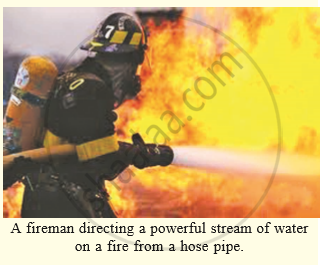
Explain why, when a fireman directs a powerful stream of water on a fire from a hose pipe, the hose pipe tends to go backward.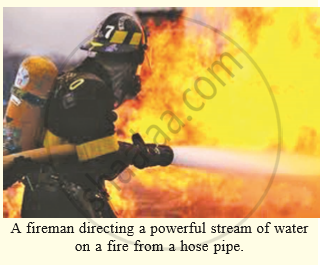
“Wearing helmet and fastening the seat belt is highly recommended for safe journey” Justify your answer using Newton’s laws of motion.
According to the third law of motion, action and reaction
Why do the action and reaction forces in a pair not cancel each other out?
What is the main characteristic of action and reaction forces?
