Advertisements
Advertisements
Question
Give a scientific reason.
When an object falls freely to the ground, its acceleration is uniform.
Advertisements
Solution
When an object falls freely to the ground, it is under the effect of a constant force known as the force of gravity. No other forces act on it. Hence, from Newton's second law of motion, we can say that this constant force of gravity accelerates the freely falling object uniformly. This uniform acceleration is known as acceleration due to gravity which acts towards the centre and is denoted by g.
APPEARS IN
RELATED QUESTIONS
Distinguish between acceleration and retardation.
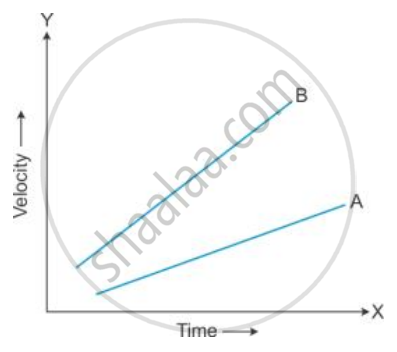
Figure shows the velocity-time graphs for two cars A and B moving in the same direction. Which car has greater acceleration? Give reasons to your answer.
Draw a graph for acceleration against time for a uniformly accelerated motion. How can it be used to find the change in speed in a certain interval of time?
A bullet initially moving with a velocity 20 m/s strikes a target and comes to rest after penetrating a distance 10 cm into the target. Calculate the retardation caused by the target.
A train starts from rest and accelerates uniformly at a rate of 2 m s−2 for 10 s. It then maintains a constant speed for 200 s. The brakes are then applied and the train is uniformly retarded and comes to rest in 50 s. Find
- The maximum velocity reached,
- The retardation in the last 50 s,
- The total distance travelled,
- The average velocity of the train.
When is the acceleration due to gravity positive?
The change in velocity of a motorbike is 54 kmh−1 in one minute. Calculate its acceleration in (a) ms−2 (b) kmh−2.
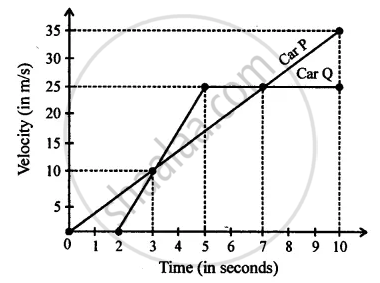
Diagram is given below shows velocity – time graph of car P and Q, starting from the same place and in the same direction. Calculate the Acceleration of car Q between 2 s – 5 s.
What does a positive acceleration mean?
The acceleration of a body is 8.5 ms-2. What does this statement mean?
A body has an acceleration of -3.5 ms-2. What is its retardation?
Sketch the shape of the velocity-time graph for a body moving with:
Uniform acceleration.
A car accelerates uniformly from a velocity of 18 km/h to 36 km/h in 15 min. What is its acceleration?
Correct your friend who says that acceleration gives the idea of how fast the position changes.
State whether true or false. If false, correct the statement.
Acceleration can get negative value also.
The slope of a velocity-time graph gives ______.
A bus accelerating with 4ms-2 changes its speed from 60ms_1 to a certain value in 5s. The final speed is ______.
