Advertisements
Advertisements
Question
A bullet initially moving with a velocity 20 m/s strikes a target and comes to rest after penetrating a distance 10 cm into the target. Calculate the retardation caused by the target.
Advertisements
Solution
Initial velocity u = 20 m/s
Final velocity v = 0
Distance travelled s = 10 cm = 0.1 m
Let acceleration be 'a'.
Using the third equation of motion,
v2 − u2 = 2as
We get,
(0) 2 − (20) 2 = 2(a) (0.1)
a = −(400/0.2) m/s2
a = −2000 m/s2
Thus, retardation = 2000 m/s2
APPEARS IN
RELATED QUESTIONS
A ball is rolling from A to D on a flat and smooth surface. Its speed is 2 cm/s. On reaching B, it was pushed continuously up to C. On reaching D from C, its speed had become 4 cm/s. It took 2 seconds for it to go from B to C. What is the acceleration of the ball as it goes from B to C?

A truck running at 90 kmh−1, is brought to rest over a distance of 25 m. Calculate the retardation and time for which brakes are applied.
A motor bike running at 90 kmh−1 is slowed down to 18 kmh−1 in 2.5 s. Calculate
- acceleration
- distance covered during slow down.
A body falls towards the earth. Does it have positive or negative acceleration?
Interpret the following graph: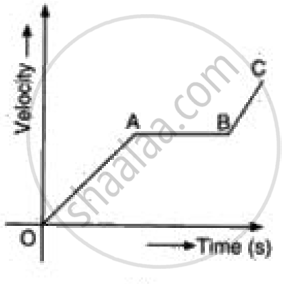
If the velocity of a body does not change, then its acceleration is ______.
The Unit of acceleration is ______.
If a moving body comes to rest, then its acceleration is ______.
If a body starts from rest, what can be said about the acceleration of the body?
Assertion: A negative acceleration of a body can be associated with speeding up of the body.
Reason: Increase in the speed of a moving body is independent of its direction of motion.
