Advertisements
Advertisements
Question
What happens to the stepwise increasing speed-time graph when the size of each step is made very small?
Advertisements
Solution
The graph becomes straight line with positive slope with time axis and represents almost a constant acceleration.
APPEARS IN
RELATED QUESTIONS
Explain the following concept in your own words with everyday examples:
Acceleration
Out of energy and acceleration, which one is a vector?
State if the following situation is possible:
A body moving horizontally with an acceleration in vertical direction.
A body has an acceleration of -3.5 ms-2. What is its retardation?
A car accelerates uniformly from a velocity of 18 km/h to 36 km/h in 15 min. What is its acceleration?
A car accelerates to a velocity of 30 m/s in 10 s and then decelerates for 20 s so that it stops. Draw a velocity-time graph to represent the motion and find:
Distance travelled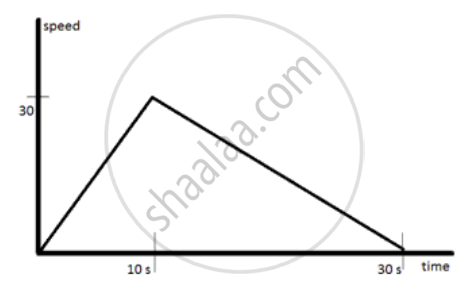
Assertion: The accelerated motion of an object may be due to change in magnitude of velocity or direction or both of them.
Reason: Acceleration can be produced only by change in magnitude of the velocity. It does not depend the direction.
The slope of a velocity-time graph gives ______.
When an object undergoes acceleration ______.
What is the difference between uniform acceleration and non–uniform acceleration?
