Advertisements
Advertisements
Question
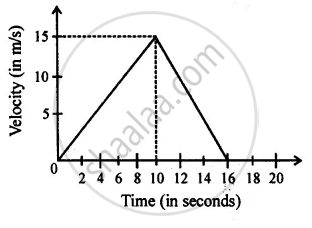
From the diagram given below, calculate deceleration.
Advertisements
Solution

Deceleration = Slope of v.t. graph from A to B
= `"AC"/"CB"=15/(16-10)=15/6` = 2.5 ms−2
APPEARS IN
RELATED QUESTIONS
Explain the following concept in your own words with everyday examples:
Acceleration
Draw velocity – time graph for the following situation:
When a body is moving with variable velocity, but uniform retardation.
Draw velocity – time graph for the following situation:
When a body is moving with variable velocity and variable acceleration.
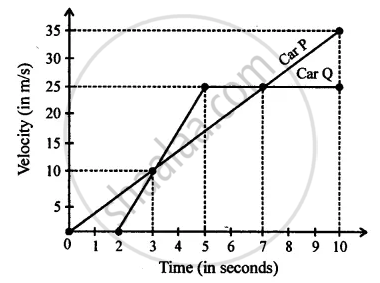
Diagram is given below shows velocity – time graph of car P and Q, starting from the same place and in the same direction. Calculate the Acceleration of car P.
A motor bike running at 5 ms−1, picks up a velocity of 30 ms−1 in 5s. Calculate
- acceleration
- distance covered during acceleration.
What is the SI unit of acceleration?
The acceleration of a moving body is constant in magnitude and direction. Must the path of the body be a straight line?
If not, given an example.
Distinguish between uniformly and non-uniformly accelerated motions.
Sketch the shape of the velocity-time graph for a body moving with:
Uniform acceleration.
When a body is said to be in
- uniform acceleration
- non–uniform acceleration?
