Advertisements
Advertisements
Question
Give an example of an accelerated body, moving with a uniform speed.
Advertisements
Solution
When a body moves over a circular path with constant speed, then body is said to be accelerated. Acceleration is produced in the body due to continuous change in its direction.
APPEARS IN
RELATED QUESTIONS
The unit of retardation is ____________
State the type of motion represented by the following sketches in Figures.
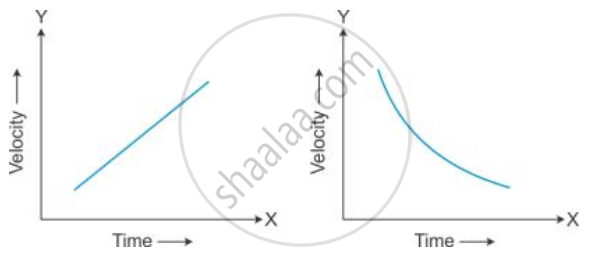
Give an example of each type of motion.
A racing car, initially at rest, picks up a velocity of 180 kmh−1 in 4.5 s. Calculate
- acceleration
- distance covered by the car.
A car accelerates to a velocity of 30 m/s in 10 s and then decelerates for 20 s so that it stops. Draw a velocity-time graph to represent the motion and find:
The Deceleration.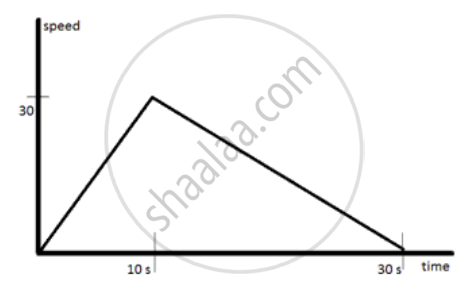
Figure represents graphically the velocity of a car moving along a straight road over a period of 100 hours.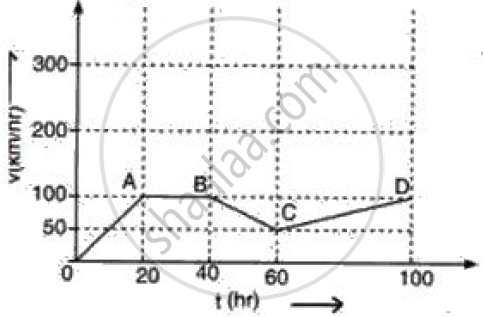
Calculate the acceleration along AB and the retardation along BC.
What do you mean by constant acceleration?
State whether true or false. If false, correct the statement.
Acceleration can get negative value also.
A bus accelerating with 4ms-2 changes its speed from 60ms_1 to a certain value in 5s. The final speed is ______.
A car is being driven at a speed of 20ms-1 when brakes are applied to bring it to rest in 5 s. The deceleration produced in this case will be ______.
An object can be moving with uniform speed but with variable acceleration.
