Advertisements
Advertisements
Question
A motor bike running at 5 ms−1, picks up a velocity of 30 ms−1 in 5s. Calculate
- acceleration
- distance covered during acceleration.
Advertisements
Solution
Initial velocity of motor bike = u = 5 ms−1
Final velocity of motor bike = v = 30 ms−1
Time = t = 5 s
(i) Acceleration = a = ?
v = u + at
30 = 5 + a (5)
5a = 30 − 5 = 25
a = `25/5` = 5 ms−2
(ii) Distance covered S =?
S = ut + `1/2` at2
S = `5(5)+1/2(5)(5)^2`
S = `25+125/2` = 25 + 62.5
S = 87.5 m
APPEARS IN
RELATED QUESTIONS
When is the acceleration due to gravity negative?
An aeroplane lands at 216 kmh−1 and stops after covering a runway of 2 m. Calculate the acceleration and the time, in which it comes to rest.
The acceleration of a body is 8.5 ms-2. What does this statement mean?
Is it possible for an accelerating body to have constant speed?
A car accelerates to a velocity of 30 m/s in 10 s and then decelerates for 20 s so that it stops. Draw a velocity-time graph to represent the motion and find:
Distance travelled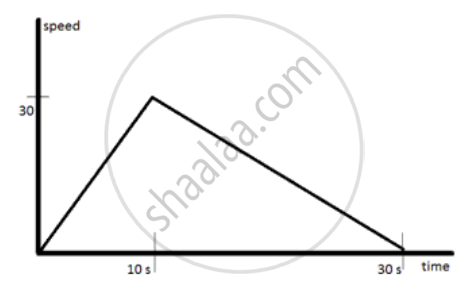
The rate of change of velocity is ______.
The slope of a velocity-time graph gives ______.
When a body starts from rest, the acceleration of the body after 2 seconds in ______ of its displacement.
Acceleration is defined as the rate of change of ______.
If a body starts from rest, what can be said about the acceleration of the body?
