Advertisements
Advertisements
प्रश्न
A motor bike running at 5 ms−1, picks up a velocity of 30 ms−1 in 5s. Calculate
- acceleration
- distance covered during acceleration.
Advertisements
उत्तर
Initial velocity of motor bike = u = 5 ms−1
Final velocity of motor bike = v = 30 ms−1
Time = t = 5 s
(i) Acceleration = a = ?
v = u + at
30 = 5 + a (5)
5a = 30 − 5 = 25
a = `25/5` = 5 ms−2
(ii) Distance covered S =?
S = ut + `1/2` at2
S = `5(5)+1/2(5)(5)^2`
S = `25+125/2` = 25 + 62.5
S = 87.5 m
APPEARS IN
संबंधित प्रश्न
A ball is rolling from A to D on a flat and smooth surface. Its speed is 2 cm/s. On reaching B, it was pushed continuously up to C. On reaching D from C, its speed had become 4 cm/s. It took 2 seconds for it to go from B to C. What is the acceleration of the ball as it goes from B to C?

Give an example of an accelerated body, moving with a uniform speed.
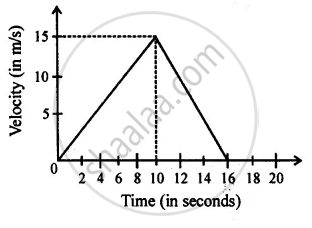
From the diagram given below, calculate deceleration.
The acceleration of a moving body is constant in magnitude and direction. Must the path of the body be a straight line?
If not, given an example.
Write the SI unit of acceleration and retardation.
State if the following situation is possible:
A body moving with a constant velocity in an accelerated motion.
Assertion: The accelerated motion of an object may be due to change in magnitude of velocity or direction or both of them.
Reason: Acceleration can be produced only by change in magnitude of the velocity. It does not depend the direction.
The speed of a particle is constant. Will it have acceleration? Justify with an example.
The acceleration of the body that moves with a uniform velocity will be ______.
An object can be moving with uniform speed but with variable acceleration.
