Advertisements
Advertisements
प्रश्न
A racing car, initially at rest, picks up a velocity of 180 kmh−1 in 4.5 s. Calculate
- acceleration
- distance covered by the car.
Advertisements
उत्तर
Initial velocity of car = u = 0
Final velocity of car = v = 180 kmh−1 = `180xx5/18` ms−1
v = 50 ms−1
Time = t = 4.5 s
v = u + at
50 = 0 + a (4.5)
4.5a = 50
a = `50/4.5` = 11.11 ms−2
(Distance) S = ut + `1/2` at2
S = `0(4.5)+1/2xx50/4.5xx(4.5)^2`
S = 0 + 25 × 4.5
S = 112.5 m
APPEARS IN
संबंधित प्रश्न
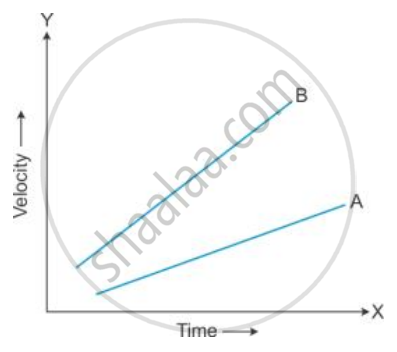
Figure shows the velocity-time graphs for two cars A and B moving in the same direction. Which car has greater acceleration? Give reasons to your answer.
A train starts from rest and accelerates uniformly at a rate of 2 m s−2 for 10 s. It then maintains a constant speed for 200 s. The brakes are then applied and the train is uniformly retarded and comes to rest in 50 s. Find
- The maximum velocity reached,
- The retardation in the last 50 s,
- The total distance travelled,
- The average velocity of the train.
A space craft flying in a straight course with velocity of 75 km s-1 fires its rocket motors for 6.0 s. At the end of this time its speed is 120 km s-1 in the same direction.
Find
(i) The space craft's average acceleration while the motors were firing
(ii) The distance travelled by the space craft in the first 10 s after the rocket motors were started, the motors being in action for only 6 s.
The change in velocity of a motorbike is 54 kmh−1 in one minute. Calculate its acceleration in (a) ms−2 (b) kmh−2.
Write the SI unit of retardation.
Convert the following acceleration:
1/36 m/s2 into km/h2
The rate of change of velocity is ______.
When a body starts from rest, the acceleration of the body after 2 seconds in ______ of its displacement.
The speed of a particle is constant. Will it have acceleration? Justify with an example.
Assertion: When a body is subjected to a uniform acceleration, it is always moving in a straight line.
Reason: Motion may be straight-line motion or circular motion.
