Advertisements
Advertisements
प्रश्न
A cyclist driving at 36 kmh−1 stops his motion in 2 s, by the application of brakes. Calculate
- retardation
- distance covered during the application of brakes.
Advertisements
उत्तर
Initial velocity = u = 36 kmh−1
= u = `36xx5/18` ms−1 = 10 ms−1
Final velocity = v = 0
Time = t = 2s
(i) Retardation = a = ?
v = u + at
0 = 10 + a (2)
2a = −10
a = `(-10)/2` = −5 ms−2
(ii) Distance covered S =?
v2 − u2 = 2aS
(0)2 − (10)2 = 2(−5) S
−10S = −100
S = `100/10`
S = 10 m
APPEARS IN
संबंधित प्रश्न
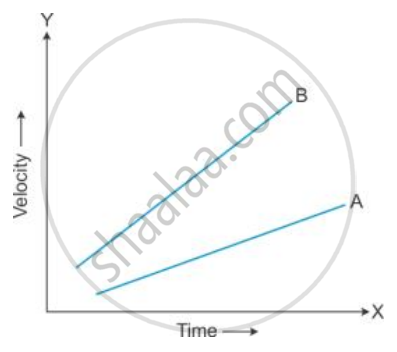
Figure shows the velocity-time graphs for two cars A and B moving in the same direction. Which car has greater acceleration? Give reasons to your answer.
Draw a graph for acceleration against time for a uniformly accelerated motion. How can it be used to find the change in speed in a certain interval of time?
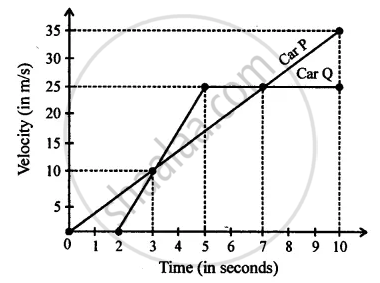
Diagram is given below shows velocity – time graph of car P and Q, starting from the same place and in the same direction. Calculate the Acceleration of car Q between 2 s – 5 s.
What does a positive acceleration mean?
Sketch the shape of the velocity-time graph for a body moving with:
Uniform acceleration.
Figure represents graphically the velocity of a car moving along a straight road over a period of 100 hours.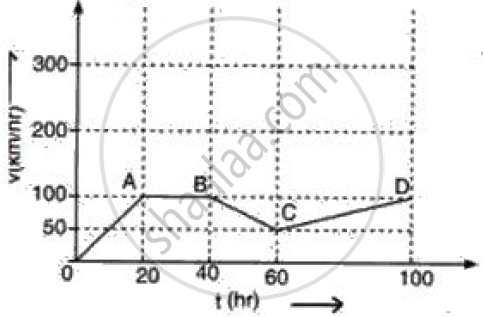
Calculate the acceleration along AB and the retardation along BC.
From the given v-t graph it can be inferred that an object is

The speed of a particle is constant. Will it have acceleration? Justify with an example.
The acceleration of the body that moves with a uniform velocity will be ______.
What is the difference between uniform acceleration and non–uniform acceleration?
