Advertisements
Advertisements
प्रश्न
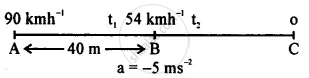
A motorbike running at 90 kmh−1, is slowed down to 54 kmh−1 by the application of brakes, over a distance of 40 m. If the brakes are applied with the same force, calculate
- total time in which bike comes to rest
- total distance travelled by bike.
Advertisements
उत्तर
Initial velocity = u = 90 kmh−1
= u = `90xx5/18` ms−1 = 25 ms−1
Final velocity = v = 54 kmh−1 = `54xx5/18` ms−1
v = 15 ms−1
Distance = S = 40 m
v2 = u2 + 2as
(15)2 = (25)2 + 2 ⋅ a ⋅ 40 ⇒ 225 = 625 + 80a ⇒ 80a = 225 − 625 = −400 ⇒ a = `(-400)/80`
a = −5 m/s2
v = u + at ⇒ 0 = 25 + (−5)t ⇒ t = `25/5` = 5 seconds
v2 = u2 + 2as ⇒ 0 = (25) 2 + 2 ⋅ (−5) ⋅ s ⇒ 625 = 10s ⇒ s = `625/10` = 62.5 m
Total time to stop = 5 seconds
Total distance before stopping = 62.5 m
APPEARS IN
संबंधित प्रश्न
A body travels a distance of 3 km towards East, then 4 km towards North and finally 9 km towards East.
What is the total distance travelled ?
How is the distance related with time for motion under uniform acceleration such as the motion of a freely falling body?
A ball moves on a smooth floor in a straight line with uniform velocity 10 m s-1 for 6 s. At t = 6 s, the ball hits a wall and comes back along the same line to the starting point with the same speed. Draw the velocity-time graph and use it to find the total distance travelled by the ball and its displacement.
Define Distance.
A racehorse runs straight towards the north and covers 540 m in one minute. Calculate
- displacement of the horse,
- its velocity in (a) ms−1 (b) kmh−1.
Show the difference between distance and displacement with the help of a diagram.
Can a body have negative displacement?
Calculate the distance and displacement in the following case: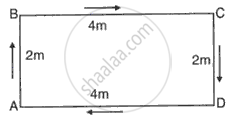
A body is moving along a circular path of radius r. What will be the distance and displacement of the body when it completes:
Full revolution
An object covers a distance of S meters in t seconds as follows :
| S (meters) | 0 | 8 | 20 | 20 | 16 | 10 | 0 |
| t (Seconds) | 80 | 2 | 5 | 10 | 12 | 15 | 10 |
Plot a graph, taking t on X-axis and S on Y-axis. Determine the velocity of the object at time
(i) 6 s, and
(ii) 14 s.
