Advertisements
Advertisements
प्रश्न
The displacement of a moving object in a given interval of time is zero. Would the distance travelled by the object also be zero? Justify your answer.
Advertisements
उत्तर
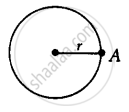
In a given interval of time, the displacement of a moving object is zero when its final position is the same as the initial position, whereas the distance travelled by the object is not zero. For example, an athlete moving on a circular track. If he starts from A and completes one round and reaches back to point A, his displacement is zero whereas the distance travelled by him is not zero but 2πr.
APPEARS IN
संबंधित प्रश्न
If on a round trip you travel 6 km and then arrive back home :
What distance have you travelled ?
What information about the motion of a body are obtained from the displacement-time graph?
The following table gives the displacement of a car at different instants of time.
| Time (s) | 0 | 1 | 2 | 3 | 4 |
| Displacement (m) | 0 | 5 | 10 | 15 | 20 |
- Draw the displacement-time sketch and find the average velocity of the car.
- What will be the displacement of the car at (i) 2.5 s and (ii) 4.5 s?
A body is moving in a straight line and its displacement at various instants of time is given in the following table
| Time (s) | 0 | 1 | 2 | 3 | 4 | 5 | 6 | 7 |
| Displacement (m) | 2 | 6 | 12 | 12 | 12 | 18 | 22 | 24 |
Plot the displacement-time graph and calculate
(i) Total distance travelled in the interval 1 s to 5 s.
(ii) Average velocity in time interval 1 s to 5 s.
Figure given below shows a velocity-time graph for a car starting from rest. The graph has three parts AB, BC and CD.
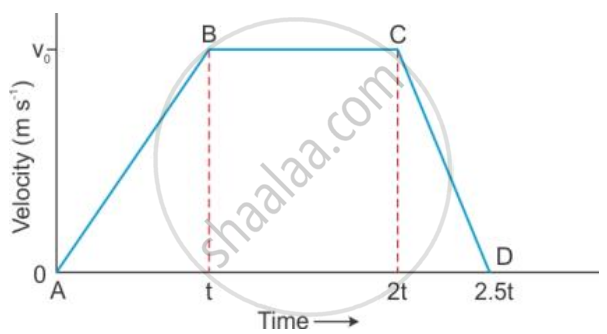
State how is the distance travelled in any part determined from this graph .
Under what condition is the displacement of a body equal to the distance traveled by it?
Calculate the distance and displacement in the following case: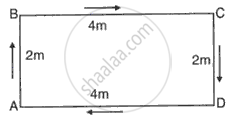
A body moves along a circular path of radius r. When it completes three complete rounds, what is the ratio of distance covered to its displacement?
The graph shows how the velocity of a scooter varies with time in 50 s.
Work out: The distance traveled in 10 s, 20 s, and 50 s.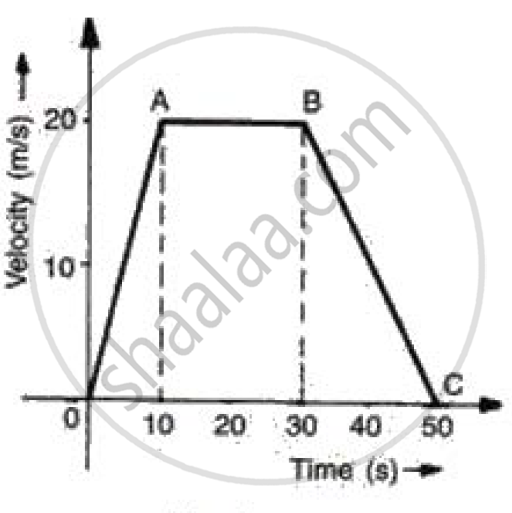
A body moves is a circle of radius ‘2R’ what is the distance covered and displacement of the body after 2 complete rounds?
