Advertisements
Advertisements
प्रश्न
The graph shows how the velocity of a scooter varies with time in 50 s.
Work out: The distance traveled in 10 s, 20 s, and 50 s.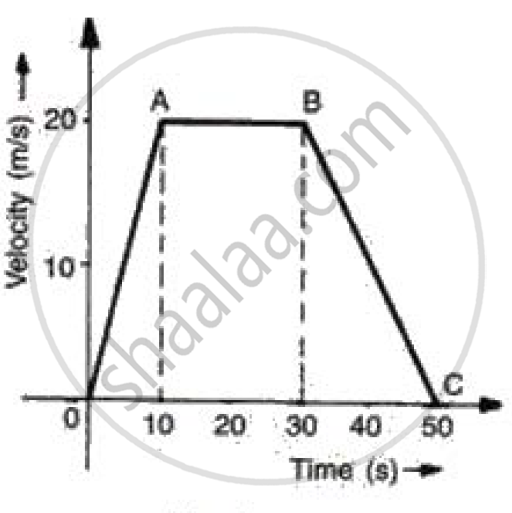
Advertisements
उत्तर

The distance travelled in 10 sec is S1 = `1/2`x20 x10 = 100 m
Distance travelled in 10s to 30s is s2 = 20 x (30 - 10) = 20 x 20 = 400 m Distance travelled in 30 s to 5os is S3 = `1/2` x20 x(50 - 30) = 200m.
Total distance covered by scooter is = 100 m + 400m + 200m =700m.
APPEARS IN
संबंधित प्रश्न
A farmer moves along the boundary of a square field of side 10 m in 40 s. What will be the magnitude of displacement of the farmer at the end of 2 minutes 20 seconds?
What is the difference between distance travelled by a body and its displacement ? Explain with the
help of a diagram.
In which of the following cases of motion, the distance moved and the magnitude of displacement are equal?
State how the velocity-time graph can be used to find The displacement of the body in a given time.
What can you say about the nature of motion of a body if its displacement-time graph is A curve.
How can you find the following?
Displacement from velocity – time graph.
Give the name of the physical quantity that corresponds to the rate of change of displacement.
Four cars A, B, C, and D are moving on a levelled road. Their distance versus time graphs are shown in Fig. 8.2. Choose the correct statement.

The rate of change of displacement ______.
If the displacement-time graph of a particle is parallel to the time axis, the velocity of the particle is ______.
