Advertisements
Advertisements
प्रश्न
Can displacement-time sketch be parallel to the displacement axis? Give a reason to your answer.
Advertisements
उत्तर
The displacement-time graph can never be parallel to the displacement axis because such a line would mean that the distance covered by the body in a certain direction increases without any increase in time, which is not possible.
APPEARS IN
संबंधित प्रश्न
A farmer moves along the boundary of a square field of side 10 m in 40 s. What will be the magnitude of displacement of the farmer at the end of 2 minutes 20 seconds?
If on a round trip you travel 6 km and then arrive back home :
What distance have you travelled ?
Can displacement be zero even if the distance is not zero? Give one example to explain your answer.
How is the distance related with time for motion under uniform acceleration such as the motion of a freely falling body?
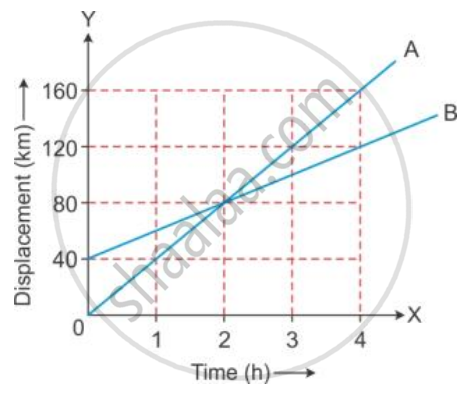
Figure ahead represents the displacement - time sketch of motion of two cars A and B . Find :
(i) the distance by which the car B was initially ahead of car A.
(ii) the velocities of car A and car B.
(iii) the time in which car A catches car B.
(iv) the distance from start when the car A will catch the car B.
A racehorse runs straight towards the north and covers 540 m in one minute. Calculate
- displacement of the horse,
- its velocity in (a) ms−1 (b) kmh−1.
Calculate the distance and displacement in the following case: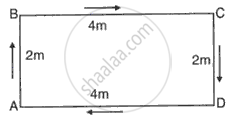
Ashok starts from his house and travels 3 km to reach his school. On finding the school gates closed, he returns to his house. What is?
The distance traveled by Ashok.
A body moves along a circular path of radius r. When it completes three complete rounds, what is the ratio of distance covered to its displacement?
A scalar quantity has ______.
