Advertisements
Advertisements
Question
Can displacement-time sketch be parallel to the displacement axis? Give a reason to your answer.
Advertisements
Solution
The displacement-time graph can never be parallel to the displacement axis because such a line would mean that the distance covered by the body in a certain direction increases without any increase in time, which is not possible.
APPEARS IN
RELATED QUESTIONS
If on a round trip you travel 6 km and then arrive back home :
What distance have you travelled ?
Is displacement a scalar quantity?
A body is moving along a circular path of radius r. What will be the distance and displacement of the body when it completes:
Half a revolution
A body is moving along a circular path of radius r. What will be the distance and displacement of the body when it completes:
Two full revolutions
The figure represents graphically the velocity of a car moving along a straight road over a period of 100 hours.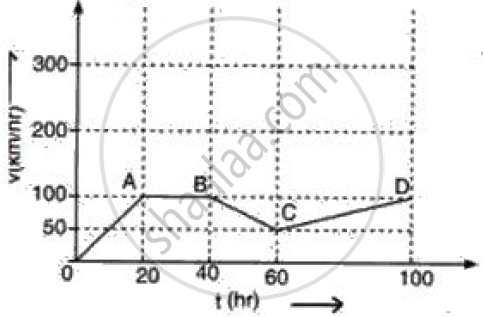
Calculate the distance travelled in the last 40 h.
Match the following.
| 1. | Displacement | Knot |
| 2. | Light travelling through vacuum | Geometric centre |
| 3. | Speed of ship | Metre |
| 4. | Centre of gravity of geometrical shaped objects | Larger base area |
| 5. | Stability | Uniform velocity |
Distinguish distance and displacement.
Distance is a ______ quantity.
A scalar quantity has ______.
Displacement magnitude can be greater than the distance traveled by the object.
