Advertisements
Advertisements
Question
A body is moving along a circular path of radius r. What will be the distance and displacement of the body when it completes:
Two full revolutions
Advertisements
Solution

Distance travelled is two times the perimeter of cirle.
So distance travelled is =4π r.
Displacement =0 as starting and ending point are coinciding.
APPEARS IN
RELATED QUESTIONS
If on a round trip you travel 6 km and then arrive back home :
What distance have you travelled ?
A body travels a distance of 3 km towards East, then 4 km towards North and finally 9 km towards East.
What is the total distance travelled ?
If the displacement of an object is proportional to the square of time, then the object is moving with :
The minimum distance between the start and finish points of the motion of an object is called the ______ of the object.
What information about the motion of a body are obtained from the displacement-time graph?
Figure given below shows a velocity-time graph for a car starting from rest. The graph has three parts AB, BC and CD.
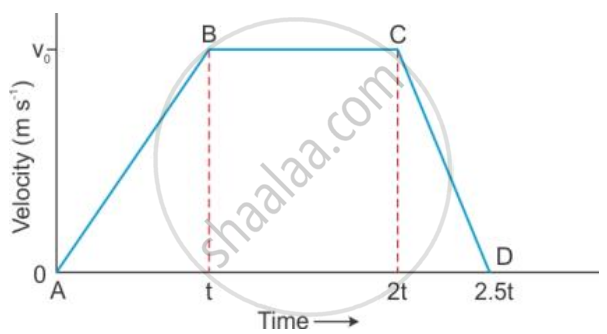
State how is the distance travelled in any part determined from this graph .
A car covers 90 km in `1 1/2` hours towards east. Calculate
- displacement of car,
- its velocity in (a) kmh−1 (b) ms−1.
Can you suggest the kind of motion of a body from the following distance – time graph?
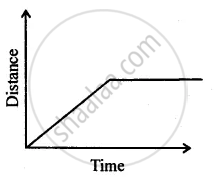
Slope of a velocity-time graph gives
A particle is moving in a circular pattern of radius r. The displacement after half a circle would be ______.
