Advertisements
Advertisements
Question
A car starts from rest and moves along the x-axis with constant acceleration 5 ms–2 for 8 seconds. If it then continues with constant velocity, what distance will the car cover in 12 seconds since it started from the rest?
Advertisements
Solution
For constant acceleration of car,
u = 0, a = 5 ms−2, t = 8 s
using s = `"ut" + 1/2 "at"^2`, we get
s1 = `0 + 1/2 xx 5 xx 8^2`
= 160 m
For constant velocity of car,
v = u + at
= 0 + 5 × 8
= 40 ms−1
t = (12 − 8) s = 4 s, a = 0
∴ s2 = vt
= 40 × 4
= 160 m
There fore, total distance covered in 12 s
= s1 + s2
= 160 + 160
= 320 m
APPEARS IN
RELATED QUESTIONS
A farmer moves along the boundary of a square field of side 10 m in 40 s. What will be the magnitude of displacement of the farmer at the end of 2 minutes 20 seconds?
Clarify the difference.
Distance and displacement
Can displacement-time sketch be parallel to the displacement axis? Give a reason to your answer.
Figure shows the velocity-time graph of a particle moving in a straight line.
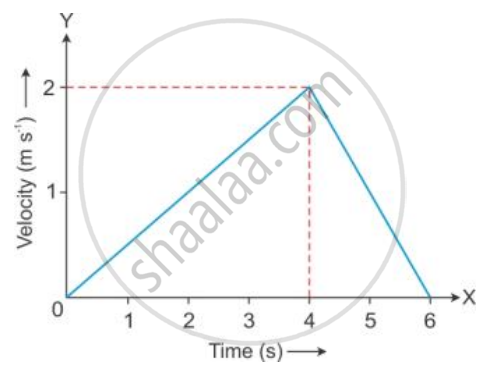
(i) State the nature of motion of particle.
(ii) Find the displacement of particle at t = 6 s.
(iii) Does the particle change its direction of motion?
(iv) Compare the distance travelled by the particle from 0 to 4 s and from 4 s to 6 s.
(v) Find the acceleration from 0 to 4 s and retardation from 4 s to 6 s.
A body starts from rest with uniform acceleration 2 m s-2. Find the distance covered by the body in 2 s.
A body is moving along a circular path of radius r. What will be the distance and displacement of the body when it completes:
Half a revolution
Ashok starts from his house and travels 3 km to reach his school. On finding the school gates closed, he returns to his house. What is?
The displacement of Ashok
______ is the length of the actual path covered by a body.
A particle is moving in a circular pattern of radius r. The displacement after half a circle would be ______.
Displacement magnitude can be greater than the distance traveled by the object.
