Advertisements
Advertisements
Question
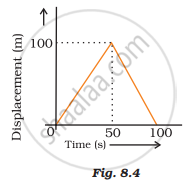
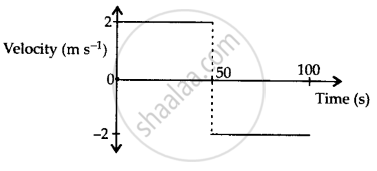
A girl walks along a straight path to drop a letter in the letterbox and comes back to her initial position. Her displacement–time graph is shown in Fig.8.4. Plot a velocity-time graph for the same.
Advertisements
Solution
From displacement – time graph,
velocity = `"displacement"/"time"`
= `(100"m")/(50"s")`
= 2ms−1
The symmetry of the graph shows that the girl comes back to her initial position with the same velocity (2 ms−1) but in opposite direction. So, the velocity-time graph will look like
APPEARS IN
RELATED QUESTIONS
A car is travelling along the road at 8 ms-1. It accelerates at 1 ms-2 for a distance of 18 m. How fast is it then travelling ?
A freely falling object travels 4.9 m in 1st second, 14.7 m in 2 nd second, 24.5 m in 3rd second, and so on. This data shows that the motion of a freely falling object is a case of :
Define velocity. State its unit.
Differentiate between uniform acceleration and variable acceleration.
What do you understand by the term acceleration?
Can you suggest a real-life example about the motion of a body from the following velocity – time graph?
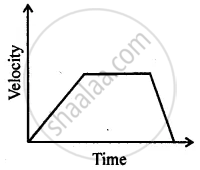
Can you suggest a real-life example about the motion of a body from the following velocity – time graph?
A packet is dropped from a stationary helicopter, hovering at a height ‘h’ from ground level, reaches the ground in 12s. Calculate
- the value of h
- final velocity of packet on reaching the ground. (Take g = 9.8 ms−2)
Area under a v – t graph represents a physical quantity which has the unit
How will the equations of motion for an object moving with a uniform velocity change?
