Advertisements
Advertisements
Question
Multiple choice Question. Select the correct option.
The speed of a car reduces from 15 m/s to 5 m/s over a displacement of 10 m. The uniform acceleration of the car is :
Options
−10 m/s2
+10 m/s2
2 m/s2
0.5 m/s2
Advertisements
Solution
−10 m/s2
Explanation:
Initial velocity = u = 15 m/s
Final velocity = v = 5 m/s
Displacement = S = 10 m
Acceleration = a = ?
v2 – u2 = 2aS ;
(5)2 – (15)2 = 2a (10)
25 – 225 = 20a
a = −220/20 = -10 ms−2
APPEARS IN
RELATED QUESTIONS
A bus decreases its speed from 80 km h−1 to 60 km h−1 in 5 s. Find the acceleration of the bus.
A body starting from rest travels with uniform acceleration. If it travels 100 m in 5 s, what is the value of acceleration ?
Derive the formula : v = u + at, where the symbols have usual meanings.
Derive the formula s= `ut+1/2at^2` , where the symbols have usual meanings.
State how the velocity-time graph can be used to find
The acceleration of a body
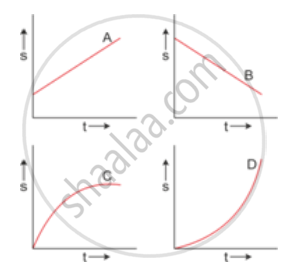
The figure shows the displacement - time graph for four bodies A, B C and D. In each case state what information do you get about the acceleration (zero, positive or negative).
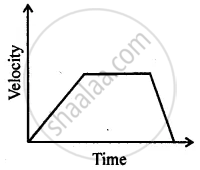
Can you suggest a real-life example about the motion of a body from the following velocity – time graph?
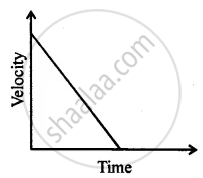
Can you suggest a real-life example about the motion of a body from the following velocity – time graph?
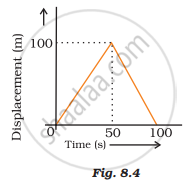
A girl walks along a straight path to drop a letter in the letterbox and comes back to her initial position. Her displacement–time graph is shown in Fig.8.4. Plot a velocity-time graph for the same.
Two stones are thrown vertically upwards simultaneously with their initial velocities u1 and u2 respectively. Prove that the heights reached by them would be in the ratio of `"u"_1^2 : "u"_2^2` (Assume upward acceleration is –g and downward acceleration to be +g)
