Advertisements
Advertisements
प्रश्न
Multiple choice Question. Select the correct option.
The speed of a car reduces from 15 m/s to 5 m/s over a displacement of 10 m. The uniform acceleration of the car is :
विकल्प
−10 m/s2
+10 m/s2
2 m/s2
0.5 m/s2
Advertisements
उत्तर
−10 m/s2
Explanation:
Initial velocity = u = 15 m/s
Final velocity = v = 5 m/s
Displacement = S = 10 m
Acceleration = a = ?
v2 – u2 = 2aS ;
(5)2 – (15)2 = 2a (10)
25 – 225 = 20a
a = −220/20 = -10 ms−2
APPEARS IN
संबंधित प्रश्न
When will you say a body is at non-uniform acceleration?
Give one example of a situation in which a body has a certain average speed but its average velocity is zero.
Name the physical quantity whose SI unit is :
(a) m/s (b) m/s2
What term is used to denote the change of velocity with time ?
Define velocity. What is the SI unit of velocity ?
A bus running at a speed of 18 km/h is stopped in 2.5 seconds by applying brakes. Calculate the retardation produced.
A car acquire a velocity of 72 km per hour in 10 second starting from rest. Find
(1) the acceleration,
(2) the average velocity, and
(3) the distance travelled in this time.
When is the positive acceleration?
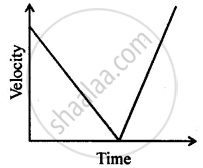
Can you suggest a real-life example about the motion of a body from the following velocity – time graph?
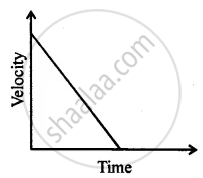
Can you suggest a real-life example about the motion of a body from the following velocity – time graph?