Advertisements
Advertisements
प्रश्न
A body is thrown vertically upward with velocity u, the greatest height h to which it will rise is,
विकल्प
`"u"/"g"`
`"u"^2/(2"g")`
`"u"^2/"g"`
`"u"/(2"g")`
Advertisements
उत्तर
`"u"^2/(2"g")`
At highest point, v = 0
Using v2– u2 = 2as, we get
0 − u2 = 2(−g)h ( ∵ a = −g and s = h)
or h = `"u"^2/(2"g")`
APPEARS IN
संबंधित प्रश्न
Fill in the following blank with a suitable word:
Acceleration is the rate of change of ______ It is measured in ______
What term is used to denote the change of velocity with time ?
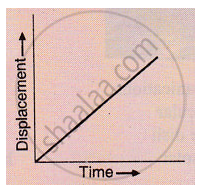
What conclusion can you draw about the velocity of a body from the displacement-time graph shown below :
When a car driver travelling at a speed of 10 m/s applies brakes and brings the car to rest in 20 s, then retardation will be :
A body starts from rest and acquires a velocity 10 m s-1 in 2 s. Find the acceleration.
A car starting from rest acquires a velocity 180m s-1 in 0.05 h. Find the acceleration.
The velocity-time graph of a body in motion is a straight line inclined to the time axis. The correct statement is ___________
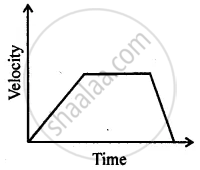
Can you suggest a real-life example about the motion of a body from the following velocity – time graph?
A stone thrown vertically upwards takes 3 s to attain maximum height. Calculate
- initial velocity of the stone
- maximum height attained by the stone. (Take g = 9.8 ms−2)
Two stones are thrown vertically upwards simultaneously with their initial velocities u1 and u2 respectively. Prove that the heights reached by them would be in the ratio of `"u"_1^2 : "u"_2^2` (Assume upward acceleration is –g and downward acceleration to be +g)
