Advertisements
Advertisements
प्रश्न
Differentiate between uniform acceleration and variable acceleration.
Advertisements
उत्तर
The acceleration is said to be uniform when equal changes in velocity take place in equal intervals of time, but if the change in velocity is not the same in the same intervals of time, the acceleration is said to be variable.
APPEARS IN
संबंधित प्रश्न
Fill in the following blank with suitable word :
Velocity is the rate of change of……………………… It is measured in.............. .
A train starting from stationary position and moving with uniform acceleration attains a speed of 36 km per hour in 10 minutes. Find its acceleration.
If a stone and a pencil are dropped simultaneously in vacuum from the top of a tower, then which of the two will reach the ground first? Give reason.
A body starts from rest and acquires a velocity 10 m s-1 in 2 s. Find the acceleration.
State how the velocity-time graph can be used to find
The acceleration of a body
When is the positive acceleration?
How can you find the following?
Velocity from acceleration – time graph.
A body is thrown vertically upward with velocity u, the greatest height h to which it will rise is,
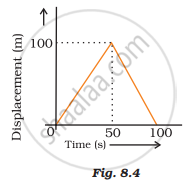
A girl walks along a straight path to drop a letter in the letterbox and comes back to her initial position. Her displacement–time graph is shown in Fig.8.4. Plot a velocity-time graph for the same.
Draw a velocity versus time graph of a stone thrown vertically upwards and then coming downwards after attaining the maximum height.
