Advertisements
Advertisements
प्रश्न
Draw a velocity versus time graph of a stone thrown vertically upwards and then coming downwards after attaining the maximum height.
Advertisements
उत्तर
When a stone is thrown vertically upwards, its velocity at the highest point is zero. As acceleration due to gravity (g) acts vertically downwards, so the upward motion of stone is uniformly decelerated and the downward motion is uniformly accelerated. This makes the velocity of stone while reaching ground equal to the initial velocity of stone. So the velocity-time graph will look like this.

Here, PQ corresponds to upward motion and QR corresponds to the downward motion of the stone.
APPEARS IN
संबंधित प्रश्न
Give one example of a situation in which a body has a certain average speed but its average velocity is zero.
Name the physical quantity whose SI unit is :
(a) m/s (b) m/s2
Fill in the following blank with suitable word :
A motorcycle has a steady……………. of 3 m/s2. This means that every………………. its…………….. increases by………….
Derive the following equations for uniformly accelerated motion:
(i) v = u + at
(ii) `"S = ut" + 1/2 "at"^2`
(iii) v2 = u2 + 2aS
where the symbols have their usual meanings.
A body, initially at rest, starts moving with a constant acceleration 2 m s-2. Calculate: (i) the velocity acquired and (ii) the distance travelled in 5 s.
Multiple choice Question. Select the correct option.
The speed of a car reduces from 15 m/s to 5 m/s over a displacement of 10 m. The uniform acceleration of the car is :
Multiple choice Question. Select the correct option.
At the maximum height, a body thrown vertically upwards has :
How can you find the following?
Acceleration from velocity – time graph.
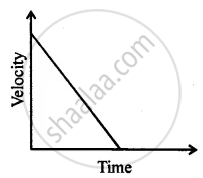
Can you suggest a real-life example about the motion of a body from the following velocity – time graph?
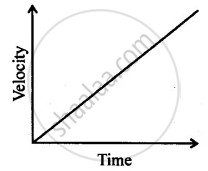
Can you suggest a real-life example about the motion of a body from the following velocity – time graph?