Advertisements
Advertisements
प्रश्न
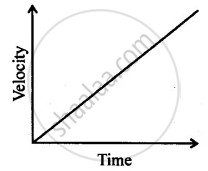
Can you suggest a real-life example about the motion of a body from the following velocity – time graph?
Advertisements
उत्तर

The figure shows that the car is moving with uniform acceleration. i.e. when velocity of car increases equally in equal intervals of time.
APPEARS IN
संबंधित प्रश्न
A bus decreases its speed from 80 km h−1 to 60 km h−1 in 5 s. Find the acceleration of the bus.
What is meant by the term acceleration ? State the SI unit of acceleration.
A cheetah starts from, rest, and accelerates at 2 m/s2 for 10 seconds. Calculate :
(a) the final velocity
(b) the distance travelled.
Derive the formula s= `ut+1/2at^2` , where the symbols have usual meanings.
A car acquire a velocity of 72 km per hour in 10 second starting from rest. Find
(1) the acceleration,
(2) the average velocity, and
(3) the distance travelled in this time.
When a car driver travelling at a speed of 10 m/s applies brakes and brings the car to rest in 20 s, then retardation will be :
A bicycle initially moving with a velocity 5.0 m s-1 accelerates for 5 s at a rate of 2 m s-2. What will be its final velocity?
State how the velocity-time graph can be used to find
The acceleration of a body
The velocity-time graph of a body in motion is a straight line inclined to the time axis. The correct statement is ___________
Two stones are thrown vertically upwards simultaneously with their initial velocities u1 and u2 respectively. Prove that the heights reached by them would be in the ratio of `"u"_1^2 : "u"_2^2` (Assume upward acceleration is –g and downward acceleration to be +g)
