Advertisements
Advertisements
प्रश्न
The velocity-time graph (Fig. 8.5) shows the motion of a cyclist. Find (i) its acceleration (ii) its velocity and (iii) the distance covered by the cyclist in 15 seconds.

Advertisements
उत्तर
Velocity-time graph is a straight line parallel to the time axis, so, the velocity of the cyclist is constant.
(i) Acceleration = 0
(ii) At, f = 15 s velocity = 20 m s’1 (from the given graph)
(iii) Distance covered by the cyclist in 15 s
= Area under v - t graph during that time interval
= 20 ms’1 x 15 s
= 300 m.
APPEARS IN
संबंधित प्रश्न
When will you say a body is at non-uniform acceleration?
A boy is sitting on a merry-go-round which is moving with a constant speed of 10 m s−1. This means that the boy is :
Which of the following could not be a unit of acceleration?
A car starting from rest acquires a velocity 180m s-1 in 0.05 h. Find the acceleration.
A bicycle initially moving with a velocity 5.0 m s-1 accelerates for 5 s at a rate of 2 m s-2. What will be its final velocity?
The velocity-time graph of a body in motion is a straight line inclined to the time axis. The correct statement is ___________
For a uniformly retarded motion, the velocity-time graph is _____________
Derive the following equations for uniformly accelerated motion:
(i) v = u + at
(ii) `"S = ut" + 1/2 "at"^2`
(iii) v2 = u2 + 2aS
where the symbols have their usual meanings.
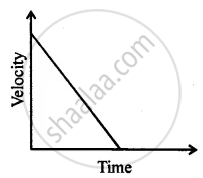
Can you suggest a real-life example about the motion of a body from the following velocity – time graph?
A stone thrown vertically upwards takes 3 s to attain maximum height. Calculate
- initial velocity of the stone
- maximum height attained by the stone. (Take g = 9.8 ms−2)
