Advertisements
Advertisements
प्रश्न
An object starting from rest travels 20 m in the first 2 s and 160 m in the next 4 s. What will be the velocity after 7 s from the start?
Advertisements
उत्तर
For first 2 s motion of object,
u = 0, f = 2 s, s = 20 m
Using s = `"ut" + 1/2 "at"^2`
we got 20 = `0 + 1/2 "a" xx 2^2`
or a = 10 ms−2
Velocity attained by object at the end of 2s
v = u + at
= 0 + 10 × 2
= 20 ms−1
For next 4s, journey of object,
t' = 4s, u' = 20 ms−1, s' = 160 m
∴ s' = `"u'""t'" + 1/2 "a'""t'"^2`
⇒ 160 = `20 xx 4 + 1/2 xx "a'" xx 4^2`
or 8a' = 80 or a' = 10 ms−2
It implies that acceleration is uniform throughout the journey.
∴ velocity after 7s from start, v = u + at
= 0 + 10 × 7
= 70 ms−1
APPEARS IN
संबंधित प्रश्न
Fill in the following blank with suitable word :
Velocity is the rate of change of……………………… It is measured in.............. .
Find the initial velocity of a car which is stopped in 10 seconds by applying brakes. The retardation due to brakes is 2.5 m/s2.
Describe the motion of a body which is accelerating at a constant rate of 10 m s–2. If the body starts from rest, how much distance will it cover in 2 s ?
Explain the meaning of the following equation of motion :v = u + at, where symbols have their usual meanings.
A freely falling object travels 4.9 m in 1st second, 14.7 m in 2 nd second, 24.5 m in 3rd second, and so on. This data shows that the motion of a freely falling object is a case of :
Differentiate between uniform acceleration and variable acceleration.
A body starts from rest and acquires a velocity 10 m s-1 in 2 s. Find the acceleration.
When is the positive acceleration?
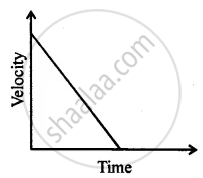
Can you suggest a real-life example about the motion of a body from the following velocity – time graph?
Area under a v – t graph represents a physical quantity which has the unit
