Advertisements
Advertisements
प्रश्न
A bicycle initially moving with a velocity 5.0 m s-1 accelerates for 5 s at a rate of 2 m s-2. What will be its final velocity?
Advertisements
उत्तर
Initial velocity of the bicycle, u = 5 m/s
Acceleration = 2 m/s2
Given time, t = 5 s
Let 'v' be the final velocity.
We know that, acceleration = Rate of change of velocity/time
= (Final velocity - Initial velocity)/time
Or 2 = (v - 5)/5
Or, 10 = (v - 5)
Or, v = 5 + 10
Or, v = 15 m/s
APPEARS IN
संबंधित प्रश्न
Fill in the following blank with suitable word :
Velocity is the rate of change of……………………… It is measured in.............. .
What is meant by the term acceleration ? State the SI unit of acceleration.
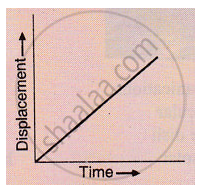
What conclusion can you draw about the velocity of a body from the displacement-time graph shown below :
Fill in the following blank with suitable word :
If a body moves with uniform velocity, its acceleration is ..............
Find the initial velocity of a car which is stopped in 10 seconds by applying brakes. The retardation due to brakes is 2.5 m/s2.
A motorcycle moving with a speed of 5 m/s is subjected to an acceleration of 0.2 m/s2. Calculate the speed of the motorcycle after 10 seconds, and the distance travelled in this time.
Give one example of following motion :
Variable acceleration
State how the velocity-time graph can be used to find
The acceleration of a body
Multiple choice Question. Select the correct option.
At the maximum height, a body thrown vertically upwards has :
An object starting from rest travels 20 m in the first 2 s and 160 m in the next 4 s. What will be the velocity after 7 s from the start?
