Advertisements
Advertisements
प्रश्न
A car is moving in a straight line with speed 18 km h-1. It is stopped in 5 s by applying the brakes. Find:
- the speed of car in m s-1
- the retardation and
- the speed of car after 2 s of applying the brakes.
Advertisements
उत्तर
Given, speed of car = 18 km h-1
(i) To convert speed to m s-1
`18 " km h"^-1 = (18 " km")/(1 " h") = (18 xx 1000 " m")/(60 xx 60 " s")`
`=> 18 " km h"^-1 = (18 xx 10 " m")/(6 xx 6 " s")`
`=> 18 " km h"^-1 = 5 "m s"^-1`
Hence, 18 km h-1 is equal to 5 m s-1.
(ii) As the car is stopped, the final velocity = 0
initial velocity (u) = 18 km h-1
As we know,
Acceleration (a) = `("Final velocity (v)" - "initial velocity (u)")/("time (t)")`
Given, Initial velocity (u) = 5 m s-1
Final velocity (v) = 0
Time (t) = 5 s
Substituting the values in the formula above, we get,
Acceleration (a) = `(0 - 5)/5`
Acceleration (a) = `- 5/5`
Acceleration (a) = - 1 ms-2
Hence, acceleration of the car is -1 m s-2. Negative sign shows that the velocity decreases with time, so retardation is 1 m s -2.
(iii) Given, t = 2 s, a = -1 m s-2, u = 5 m s-1
Substituting the values in the formula for acceleration, we get,
`=> - 1 "ms"^-2 = ((v - 5)"ms"^-1)/(2s)`
`=> -2ms^-1 = (v - 5)ms^-1`
⇒ v = (5 - 2) ms-1
⇒ v = 3 ms-1
Hence, the speed of car after 2 s of applying the brakes = 3 m s-1.
APPEARS IN
संबंधित प्रश्न
What do the following measure in a car ?
(a) Speedometer (b) Odometer
Under which condition is the magnitude of average velocity equal to average speed ?
Write the formula for acceleration. Give the meaning of each symbol which occurs in it.
Express the following in m s−1.
1 km h−1
The velocity-time graph of a moving body is given below in Figure
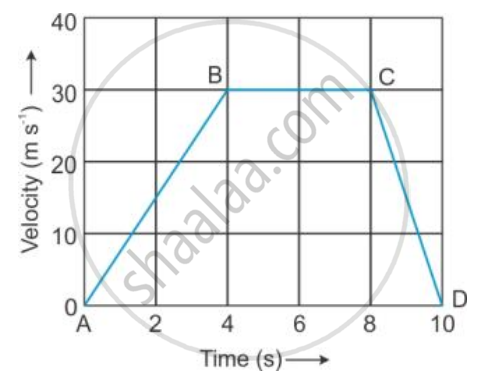
The acceleration in parts AB, BC and CD.
A body moves from rest with uniform acceleration and travels 270 m in 3 s. Find the velocity of the body at 10 s after the start.
A train is moving with a velocity of 90 km h-1 . It is brought to stop by applying the brakes which produce a retardation of 0.5 ms-2 Find :
(i) The velocity after 10 s , and
(ii) the time taken by the train to come to rest .
A body projected vertically up with a velocity of 10 m/s reaches a height of 20 m. If it is projected with a velocity of 20 m/s, then the maximum height reached by the body is:
Define speed of a body.
What are the uses of equations of motion?
