Advertisements
Advertisements
Question
A car is moving in a straight line with speed 18 km h-1. It is stopped in 5 s by applying the brakes. Find:
- the speed of car in m s-1
- the retardation and
- the speed of car after 2 s of applying the brakes.
Advertisements
Solution
Given, speed of car = 18 km h-1
(i) To convert speed to m s-1
`18 " km h"^-1 = (18 " km")/(1 " h") = (18 xx 1000 " m")/(60 xx 60 " s")`
`=> 18 " km h"^-1 = (18 xx 10 " m")/(6 xx 6 " s")`
`=> 18 " km h"^-1 = 5 "m s"^-1`
Hence, 18 km h-1 is equal to 5 m s-1.
(ii) As the car is stopped, the final velocity = 0
initial velocity (u) = 18 km h-1
As we know,
Acceleration (a) = `("Final velocity (v)" - "initial velocity (u)")/("time (t)")`
Given, Initial velocity (u) = 5 m s-1
Final velocity (v) = 0
Time (t) = 5 s
Substituting the values in the formula above, we get,
Acceleration (a) = `(0 - 5)/5`
Acceleration (a) = `- 5/5`
Acceleration (a) = - 1 ms-2
Hence, acceleration of the car is -1 m s-2. Negative sign shows that the velocity decreases with time, so retardation is 1 m s -2.
(iii) Given, t = 2 s, a = -1 m s-2, u = 5 m s-1
Substituting the values in the formula for acceleration, we get,
`=> - 1 "ms"^-2 = ((v - 5)"ms"^-1)/(2s)`
`=> -2ms^-1 = (v - 5)ms^-1`
⇒ v = (5 - 2) ms-1
⇒ v = 3 ms-1
Hence, the speed of car after 2 s of applying the brakes = 3 m s-1.
APPEARS IN
RELATED QUESTIONS
Name the physical quantity which gives us an idea of how slow or fast a body is moving.
State whether speed is a scalar or a vector quantity. Give reason for your choice.
Convert a speed of 54 km/h into m/s.
Which of the following statement is correct regarding velocity and speed of a moving body?
Which of the following can sometimes be 'zero' for a moving body?
(i) average velocity
(ii) distance travelled
(iii) average speed
(iv) displacement
What do you mean by motion in one direction?
Give an example of motion in which the average speed is not zero but the average velocity is zero.
A car moving on a straight path covers a distance of 1 km due east in 100 s. What is velocity of the car?
Figure shows the displacement of a body at different times .
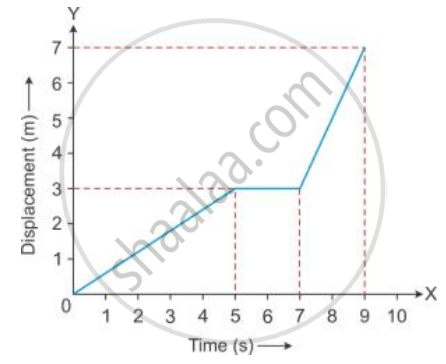
Calculate the average velocity during the time interval 5 s to 9 s ,
[Hint : From 5 s to 9 s , displacement = 7 m - 3m = 4m]
A speeding car changes its velocity from 108 kmh−1 to 36 kmh−1 in 4 s. Calculate its deceleration in
- ms−2
- kmh−2.
