Advertisements
Advertisements
Question
Joseph jogs from one end A to the other end B of a straight 300 m road in 2 minutes 30 seconds and then turns around and jogs 100 m back to point C in another 1 minute. What are Joseph’s average speeds and velocities in jogging?
- from A to B and
- from A to C?
Advertisements
Solution
(a) From A to B.
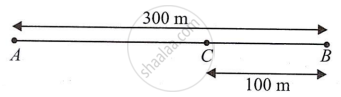
Time for A to B = 2 min 30s
= 2 × 60 + 30
= 150 s
`"Average speed" = "total distance"/ "time interval"`
= `300/150`
= 2 ms-1
`"Average velocity" = "displacement"/ "time interval"`
= `300/150`
= 2 ms-1
(b) From A to C.
Time taken = A to B + B to C
= 150 + 60
= 210 s
Total distance = 300 + 100
= 400 m
∴ `"Average speed" = "total distace"/"time interval"`
= `400/210 `
= 1.9 m s-1
∴ `"Average velocity" = "displacement"/"time interval"`
= `200/210`
= 0.95 ms-1
RELATED QUESTIONS
What does the odometer of an automobile measure?
Name the physical quantity which gives us an idea of how slow or fast a body is moving.
Arrange the following speed in increasing order (keeping the least speed first):
A bicycle moving with a speed of 200 m/min.
A train travels the first 15 km at a uniform speed of 30 km/h; the next 75 km at a uniform speed of 50 km/h; and the last 10 km at a uniform speed of 20 km/h. Calculate the average speed for the entire train journey.
A car is moving along a straight road at a steady speed. It travels 150 m in 5 seconds:
What is its average speed ?
Which of the following statement is correct regarding velocity and speed of a moving body?
Which of the following can sometimes be 'zero' for a moving body?
(i) average velocity
(ii) distance travelled
(iii) average speed
(iv) displacement
Which of the following could not be a unit of speed?
What is the relation between distance and time when the body is moving with uniform velocity?
Write down the type of motion of a body along with the A – O – B of the following distance – time graph.