Advertisements
Advertisements
Question
Abdul, while driving to school, computes the average speed for his trip to be 20 km h−1. On his return trip along the same route, there is less traffic and the average speed is 30 km h−1. What is the average speed for Abdul’s trip?
Advertisements
Solution
Let the school be at a distance of x km. If
t1 is the time taken to reach the school, then
`t_1 = "distance"/"average speed" = x/20`
If t2 is the time taken to reach back, then
`t_2 = "distance"/"average speed" = x/30`
Total time,
t = `t_1 + t_2`
= `x/20 + x/30 `
= `x [1/20 + 1/30]`
= `(5x)/60`
= `x/12`
Total distance x + x = 2x
Average speed = `"total distance"/"total time"`
= `(2x)/(x/12)`
= 24 km h-1
APPEARS IN
RELATED QUESTIONS
During an experiment, a signal from a spaceship reached the ground station in five minutes. What was the distance of the spaceship from the ground station? The signal travels at the speed of light, that is, 3 × 10⁸m s−1.
Joseph jogs from one end A to the other end B of a straight 300 m road in 2 minutes 30 seconds and then turns around and jogs 100 m back to point C in another 1 minute. What are Joseph’s average speeds and velocities in jogging?
- from A to B and
- from A to C?
Change the speed of 6 m/s into km/h.
Name the physical quantity obtained by dividing ‘Distance travelled’ by ‘Time taken’ to travel that distance.
A car is moving along a straight road at a steady speed. It travels 150 m in 5 seconds:
How far does it travel in 6 seconds ?
Give one example of a motion where an object does not change its speed but its direction of motion changes continuously.
One of the following is not a vector quantity. This one is :
Express 15 m s-1 in km h-1.
A train travels with a speed of 60 km h-1 from station A to station B and then comes back with a speed 80 km h-1 from station B to station A. Find -
- The average speed
- The average velocity of the train.
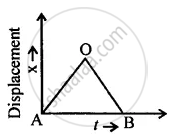
Write down the type of motion of a body along with the A – O – B of the following distance – time graph.