Advertisements
Advertisements
Question
A body moves from rest with uniform acceleration and travels 270 m in 3 s. Find the velocity of the body at 10 s after the start.
Advertisements
Solution
Initial velocity u = 0 m/s
Distance travelled s = 270 m
Time taken to travel s distance = 3 s
Let 'a' be the uniform acceleration.
Using the second equation of motion,
S = ut + (1/2) at2
We get,
270 = 0 + (1/2) a (3)2
270 = 9a/2
a = 60 m/s2
Let v be the velocity of the body 10 s after the start.
Using the first equation of motion, we get
v = u + at
v = 0 + (60)(10) = 600 m/s-1
APPEARS IN
RELATED QUESTIONS
Abdul, while driving to school, computes the average speed for his trip to be 20 km h−1. On his return trip along the same route, there is less traffic and the average speed is 30 km h−1. What is the average speed for Abdul’s trip?
A snail covers a distance of 100 metres in 50 hours. Calculate the average speed of snail in km/h.
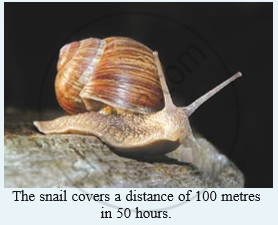
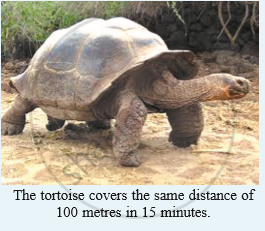
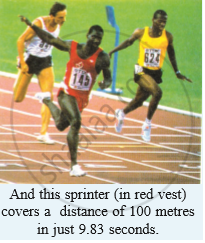
A car is moving along a straight road at a steady speed. It travels 150 m in 5 seconds:
How far does it travel in 6 seconds ?
Give an example of motion in which the average speed is not zero but the average velocity is zero.
Which of the quantity-velocity or acceleration-determines the direction of motion?
A car accelerates at a rate of 5 m s-2. Find the increase in its velocity in 2 s.
A train travels with a speed of 60 km h-1 from station A to station B and then comes back with a speed 80 km h-1 from station B to station A. Find -
- The average speed
- The average velocity of the train.
What are the uses of equations of motion?
Give two examples of uniform circular motion from your daily life.
