Advertisements
Advertisements
Question
The velocity-time graph of a moving body is given below in Figure
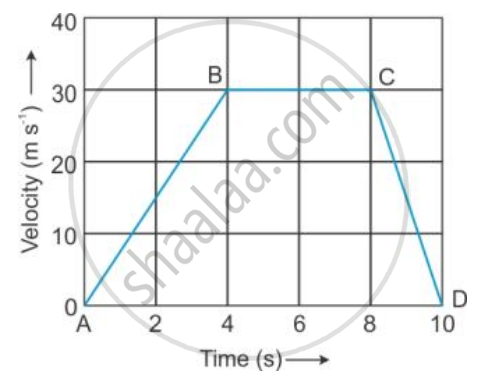
Displacement in each part AB, BC and CD.
Advertisements
Solution
Displacement of part AB = Area of ΔAB4 = (1/2) (4) (30)
= 60 m
Displacement of part BC = Area of rectangle 4BC8
= (30) × (4) = 120 m
Displacement of part CD = Area of ΔC8D = (1/2) (2) (30)
= 30 m
APPEARS IN
RELATED QUESTIONS
What does the odometer of an automobile measure?
During an experiment, a signal from a spaceship reached the ground station in five minutes. What was the distance of the spaceship from the ground station? The signal travels at the speed of light, that is, 3 × 10⁸m s−1.
If a sprinter runs a distance of 100 metres in 9.83 seconds, calculate his average speed in km/h.
A car is moving along a straight road at a steady speed. It travels 150 m in 5 seconds:
What is its average speed ?
A train starting from rest moves with a uniform acceleration of 0.2 m/s2 for 5 minutes. Calculate the speed acquired and the distance travelled in this time.
The speed of a moving object is determined to be 0.06 m/s. This speed is equal to :
When is a body said to be in motion?
Give an example of motion in which the average speed is not zero but the average velocity is zero.
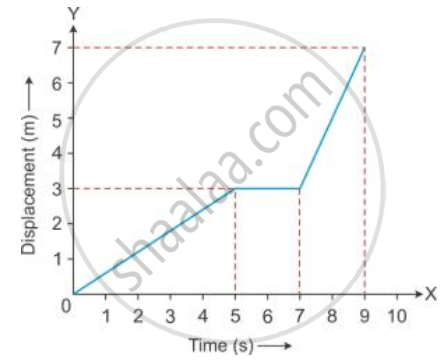
Figure shows the displacement of a body at different times .
Calculate the velocity of the body as it moves for time interval :
(i) 0 to 5 s,
(ii) 5 s to 7 s
(iii) 7 s to 9 s.
Distinguish between speed and velocity.
