Advertisements
Advertisements
Question
The velocity-time graph of a moving body is given below in Figure
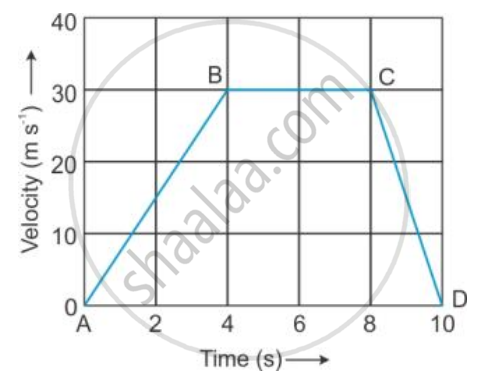
The acceleration in parts AB, BC and CD.
Advertisements
Solution
Acceleration in the part AB = Slope of AB
= tan (∠BAD)
= (30/4) ms-2
= 7.5 ms-2
Acceleration in the part BC = 0 ms-2
Acceleration in the part CD = slope of CD = -tan (∠CDA)
= -(30/2) ms-2
= -15 ms-2
APPEARS IN
RELATED QUESTIONS
Under what condition(s) is the magnitude of average velocity of an object equal to its average speed?
Abdul, while driving to school, computes the average speed for his trip to be 20 km h−1. On his return trip along the same route, there is less traffic and the average speed is 30 km h−1. What is the average speed for Abdul’s trip?
Bus X travels a distance of 360 km in 5 hours whereas bus Y travels a distance of 476 km in 7 hours. Which
bus travels faster ?
If a bus travelling at 20 m/s is subjected to a steady deceleration of 5 m/s2, how long will it take to come to rest ?
The distance between Delhi and Agra is 200 km. A train travels the first 100 km at a speed of 50 km/h. How fast must the train travel the next 100 km, so as to average 70 km/h for the whole journey ?
Which of the following can sometimes be 'zero' for a moving body?
(i) average velocity
(ii) distance travelled
(iii) average speed
(iv) displacement
When is a body said to be in motion?
Arrange the following speeds in increasing order.
10 m s-1, 1 km min-1 and 18 km h-1.
Define average velocity and give one example.
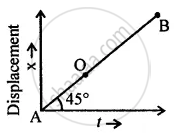
Write down the type of motion of a body along with the A – O – B of the following distance – time graph.