Advertisements
Advertisements
प्रश्न
The velocity-time graph of a moving body is given below in Figure
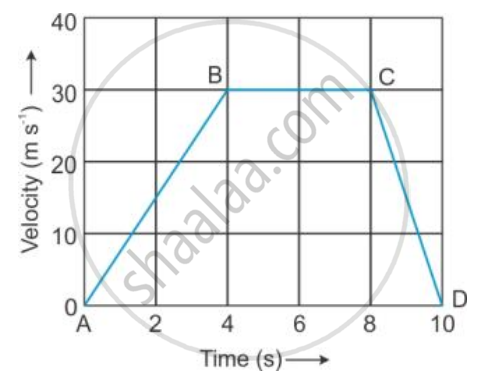
The acceleration in parts AB, BC and CD.
Advertisements
उत्तर
Acceleration in the part AB = Slope of AB
= tan (∠BAD)
= (30/4) ms-2
= 7.5 ms-2
Acceleration in the part BC = 0 ms-2
Acceleration in the part CD = slope of CD = -tan (∠CDA)
= -(30/2) ms-2
= -15 ms-2
APPEARS IN
संबंधित प्रश्न
Change the speed of 6 m/s into km/h.
Name the physical quantity obtained by dividing ‘Distance travelled’ by ‘Time taken’ to travel that distance.
In addition to speed, what else should we know to predict the position of a moving body ?
Fill in the following blank with suitable word:
The physical quantity which gives both, the speed and direction of motion of a body is called its……………
Arrange the following speed in increasing order (keeping the least speed first):
An athlete running with a speed of 10 m/s.
A ball hits a wall horizontally at 6.0 m s-1. It rebounds horizontally at 4.4 m s-1. The ball is in contact with the wall for 0.040 s. What is the acceleration of the ball ?
Which of the following statement is correct regarding velocity and speed of a moving body?
A train is moving with a velocity of 90 km h-1 . It is brought to stop by applying the brakes which produce a retardation of 0.5 ms-2 Find :
(i) The velocity after 10 s , and
(ii) the time taken by the train to come to rest .
Draw a diagram to show the motion of a body whose speed remains constant, but velocity changes continuously.
What are the uses of equations of motion?
