Advertisements
Advertisements
प्रश्न
The velocity-time graph of a moving body is given below in Figure
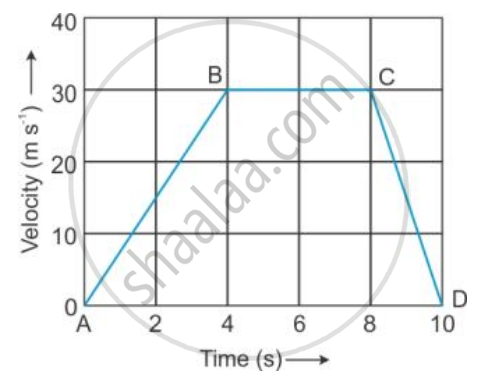
Displacement in each part AB, BC and CD.
Advertisements
उत्तर
Displacement of part AB = Area of ΔAB4 = (1/2) (4) (30)
= 60 m
Displacement of part BC = Area of rectangle 4BC8
= (30) × (4) = 120 m
Displacement of part CD = Area of ΔC8D = (1/2) (2) (30)
= 30 m
APPEARS IN
संबंधित प्रश्न
What name is given to the speed in a specified direction ?
Bus X travels a distance of 360 km in 5 hours whereas bus Y travels a distance of 476 km in 7 hours. Which
bus travels faster ?
The distance between Delhi and Agra is 200 km. A train travels the first 100 km at a speed of 50 km/h. How fast must the train travel the next 100 km, so as to average 70 km/h for the whole journey ?
A train travels the first 15 km at a uniform speed of 30 km/h; the next 75 km at a uniform speed of 50 km/h; and the last 10 km at a uniform speed of 20 km/h. Calculate the average speed for the entire train journey.
A car is moving along a straight road at a steady speed. It travels 150 m in 5 seconds:
How far does it travel in 6 seconds ?
A car is moving along a straight road at a steady speed. It travels 150 m in 5 seconds:
How long does it take to travel 240 m ?
Which of the following can sometimes be 'zero' for a moving body?
(i) average velocity
(ii) distance travelled
(iii) average speed
(iv) displacement
A car moving on a straight path covers a distance of 1 km due east in 100 s. What is velocity of the car?
A car accelerates at a rate of 5 m s-2. Find the increase in its velocity in 2 s.
A motorcyclist drives from A to B with a uniform speed of 30 km h–1 and returns back with a speed of 20 km h–1. Find its average speed.
