Advertisements
Advertisements
प्रश्न
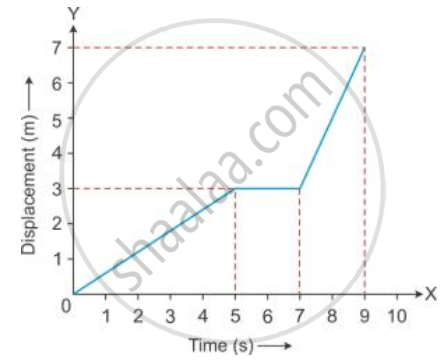
Figure shows the displacement of a body at different times .
Calculate the velocity of the body as it moves for time interval :
(i) 0 to 5 s,
(ii) 5 s to 7 s
(iii) 7 s to 9 s.
Advertisements
उत्तर
(a) (i) Velocity from 0 to 5 s = Displacement /time
= (3/5) m/s
= 0.6 m/s-1
(ii) Velocity from 5 s to 7 s = Displacement /time
= (0/2) m/s
= 0 m/s-1.
(iii) Velocity from 7 s to 9 s = Displacement /time
= (7 - 3)/(9 - 7) m/s
= (4/2) m/s
= 2 m/s-1
APPEARS IN
संबंधित प्रश्न
Change the speed of 6 m/s into km/h.
Name the physical quantity which gives us an idea of how slow or fast a body is moving.
Bus X travels a distance of 360 km in 5 hours whereas bus Y travels a distance of 476 km in 7 hours. Which
bus travels faster ?
A motorcyclist drives from place A to B with a uniform speed of 30 km h-1 and returns from place B to A with a uniform speed of 20 km h-1. Find his average speed.
Convert a speed of 54 km/h into m/s.
A car is moving along a straight road at a steady speed. It travels 150 m in 5 seconds:
How long does it take to travel 240 m ?
Give an example of motion in which the average speed is not zero but the average velocity is zero.
A car accelerates at a rate of 5 m s-2. Find the increase in its velocity in 2 s.
What is the relation between distance and time when the body is moving with variable velocity?
A speeding car changes its velocity from 108 kmh−1 to 36 kmh−1 in 4 s. Calculate its deceleration in
- ms−2
- kmh−2.
