Advertisements
Advertisements
प्रश्न
A body is moving in a straight line and its displacement at various instants of time is given in the following table
| Time (s) | 0 | 1 | 2 | 3 | 4 | 5 | 6 | 7 |
| Displacement (m) | 2 | 6 | 12 | 12 | 12 | 18 | 22 | 24 |
Plot the displacement-time graph and calculate
(i) Total distance travelled in the interval 1 s to 5 s.
(ii) Average velocity in time interval 1 s to 5 s.
Advertisements
उत्तर
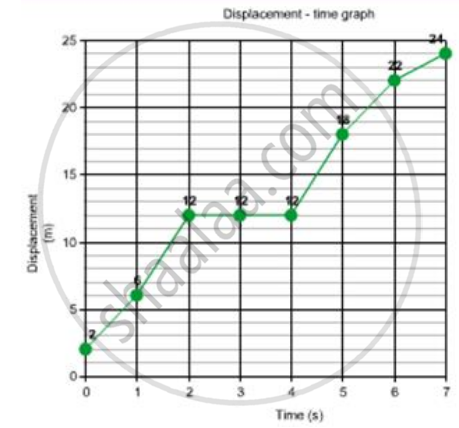
(i) Total distance travelled in interval 1s to 5s = 18m - 6m = 12 m.
(ii) Average velocity = Total displacement in the given time interval/Time interval, i.e. 1 s to 5 s.
Or, Average velocity = 12 m/4 s = 3 m/s.
APPEARS IN
संबंधित प्रश्न
What can you say about the nature of motion of a body if its displacement-time graph is A straight line inclined to the time axis with an acute angle?
What can you say about the nature of motion of a body if its displacement-time graph is A straight line inclined to the time axis with an obtuse angle?
Give an example of a body which covers a certain distance, but its displacement is zero.
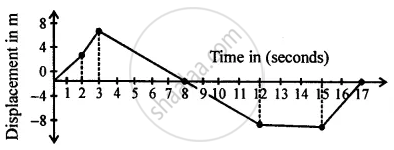
From the displacement – time graph shown given below calculate:
- Average velocity in the first three seconds.
- Displacement from the initial position at the end of 13 s.
- Time after which the body is at the initial position,
- Average velocity after 8 s.
Write two differences between distance and displacement.
A particle is moving in a circular path of radius r. The displacement after half a circle would be
Displacement / Time : Velocity :: Speed / Time : ______.
Assertion: Displacement of a body may be zero when distance travelled by it is not zero.
Reason: The displacement is the shortest distance between initial and final position.
Four cars A, B, C, and D are moving on a levelled road. Their distance versus time graphs are shown in Fig. 8.2. Choose the correct statement.

______ is the length of the actual path covered by a body.
